
 9 min read

Introduction
Texas has a growing and diverse construction market, creating opportunities for MEP engineering firms across residential, commercial, healthcare, industrial, and mixed-use projects. As firms take on more assignments, they often need additional engineering resources, better project coordination, and more efficient production workflows.
However, expanding an MEP engineering business does not always mean hiring more full-time employees. Recruitment costs, employee onboarding, salaries, software expenses, and resource management can make traditional expansion difficult, particularly when project workloads fluctuate.
For small and mid-sized MEP firms, working with offshore engineering teams can provide a flexible way to increase production capacity without building a larger permanent workforce.
By combining in-house engineering expertise with external engineering support, Texas MEP firms can manage more projects, improve resource utilization, and respond to changing client demands.
This article explores how MEP firms in Texas can scale their engineering operations through effective collaboration with offshore teams.
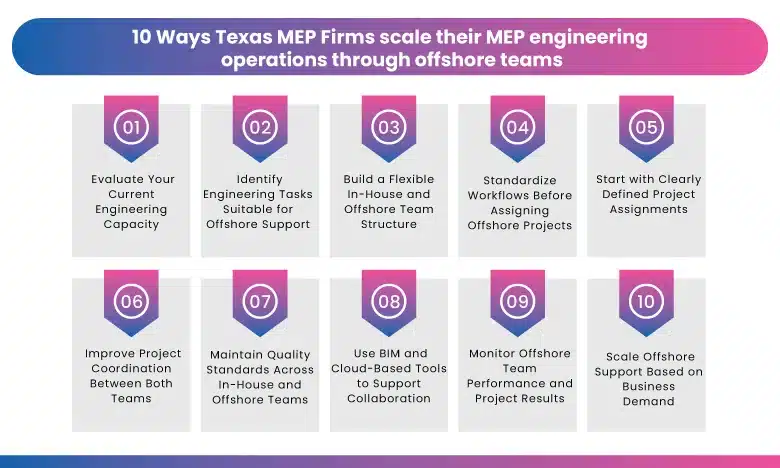
10 Ways Texas MEP Firms scale their MEP engineering operations through offshore teams
1. Evaluate Your Current Engineering Capacity
Before expanding engineering operations, MEP firms should understand their existing resources and identify where additional support is required.
Many firms experience workload challenges because their engineers are managing multiple responsibilities simultaneously. These may include design development, drafting, BIM modeling, coordination, drawing revisions, client communication, and quality reviews.
When the same team handles every project activity, production capacity can become limited.
MEP firms should evaluate:
- Number of active projects and upcoming assignments
- Availability of engineers across different disciplines
- Current project backlogs
- Time spent on design production and documentation
- Upcoming client deadlines
- Areas where additional engineering support is needed
This evaluation helps firm owners identify which activities can be supported by offshore teams and where internal engineering resources should remain focused.
2. Identify Engineering Tasks Suitable for Offshore Support
Not every engineering responsibility needs to be handled by the in-house team. MEP firms can identify production activities that can be assigned to offshore engineering partners while keeping important project decisions under internal control.
For example, senior engineers and project managers can focus on design decisions, client requirements, technical reviews, and coordination, while offshore teams support drawing production and BIM-related activities.
Common tasks that can be supported by offshore teams include:
- HVAC design and drafting
- Electrical and plumbing drawing production
- Revit MEP modeling
- BIM coordination and clash detection
- Construction documentation
- Redline implementation and drawing revisions
- Quantity takeoffs
- Revit family creation
Identifying suitable tasks before starting an outsourcing arrangement helps firms establish clear responsibilities and make better use of external resources.
3. Build a Flexible In-House and Offshore Team Structure
A successful offshore arrangement should complement the existing engineering team rather than operate as a disconnected production unit.
Texas MEP firms can establish a hybrid working structure in which internal employees manage project requirements and engineering decisions, while offshore engineers provide additional production capacity.
A typical responsibility structure may look like this:
| In-house MEP team | Offshore engineering team |
|---|---|
| Client communication | Drawing production |
| Project scope management | Revit MEP modeling |
| Engineering decisions | BIM modeling support |
| Design review and approval | Redline implementation |
| Project coordination | Documentation updates |
| Final quality control | Assigned production tasks |
This division allows the internal team to maintain project oversight while offshore resources help manage production requirements.
The exact responsibilities should depend on the firm’s project scope, contractual obligations, professional licensing requirements, and internal review procedures.
4. Standardize Workflows Before Assigning Offshore Projects
When multiple teams work on the same project, inconsistent workflows can create communication problems, duplicated work, and unnecessary revisions.
Before assigning projects to an offshore team, MEP firms should establish standard procedures for handling project information and deliverables.
These procedures should cover:
- Project kickoff and information sharing
- Drawing templates and documentation standards
- Revit model requirements
- File naming conventions
- Revision tracking
- Task assignment and deadlines
- Internal review procedures
- Communication and reporting expectations
Standardized workflows help offshore engineers understand how the firm operates and reduce the time required to manage individual assignments.
5. Start with Clearly Defined Project Assignments
Instead of immediately transferring large portions of engineering work to an offshore team, MEP firms should begin with clearly defined assignments.
A smaller project or a specific production package can help both teams understand each other’s working methods, communication expectations, and quality standards.
For example, an MEP firm may initially assign:
- Revit modeling for a specific building area
- HVAC drawing production
- Electrical layout updates
- Plumbing documentation
- Redline implementation
- BIM coordination support
Once the offshore team becomes familiar with the firm’s requirements, the working relationship can gradually expand to support more projects and engineering activities.
This approach helps firms build confidence and establish a reliable collaboration process.
6. Improve Project Coordination Between Both Teams
Effective coordination is essential when in-house and offshore engineers work together.
Differences in working hours, communication methods, project priorities, and information availability can create delays if responsibilities are not clearly defined.
MEP firms should establish regular communication procedures to keep both teams aligned.
Useful practices include:
- Assigning a dedicated project coordinator.
- Sharing updated project backgrounds and specifications.
- Providing clear instructions for each assignment.
- Maintaining a centralized revision log.
- Scheduling regular progress reviews.
- Tracking pending questions and approvals.
- Communicating changes as soon as they are confirmed.
Texas firms working with offshore teams should also establish overlapping working hours for important discussions and time-sensitive project decisions.
Clear coordination helps prevent misunderstandings and keeps project work moving between teams.
7. Maintain Quality Standards Across In-House and Offshore Teams
Scaling engineering operations should not result in inconsistent deliverables or reduced design quality.
MEP firms should ensure that offshore teams follow the same documentation standards, project requirements, and review procedures used internally.
A consistent quality-control process should include:
- Reviewing drawings against project requirements.
- Checking coordination between engineering disciplines.
- Verifying drawing annotations and schedules.
- Reviewing Revit models and documentation.
- Confirming that revision comments are addressed.
- Checking deliverables before client submission.
The in-house engineering team should retain responsibility for reviewing and approving deliverables according to the firm’s professional and contractual requirements.
This helps maintain consistency as more production work is handled externally.
8. Use BIM and Cloud-Based Tools to Support Collaboration
BIM platforms and cloud-based project management tools can make it easier for in-house and offshore engineers to work on shared project requirements.
For MEP firms managing multiple assignments, these tools help organize project information, track revisions, review models, and coordinate engineering activities.
They can support:
- Centralized project file management
- Revit model sharing
- Drawing revision tracking
- BIM coordination reviews
- Design comment management
- Progress monitoring
- Access to updated project information
However, firms should establish clear file access permissions, version-control procedures, and model-sharing standards to prevent teams from working with outdated information.
9. Monitor Offshore Team Performance and Project Results
After establishing an offshore working relationship, MEP firms should regularly evaluate whether the arrangement is supporting their operational goals.
Performance should not be measured only by the number of drawings or models completed. Firms should also consider quality, communication, responsiveness, coordination, and the ability to meet agreed deadlines.
Useful performance indicators include:
- On-time task completion rate
- Number of revisions required
- Drawing review outcomes
- Response time to project questions
- Production capacity
- Quality of documentation
- Overall project coordination
Regular performance reviews help firms identify workflow improvements and determine whether additional offshore resources are needed.
10. Scale Offshore Support Based on Business Demand
Project demand does not always remain consistent throughout the year. An MEP firm may have several projects starting at once, followed by periods with fewer active assignments.
Maintaining enough permanent employees for peak workloads can increase operating expenses during slower periods.
Offshore engineering support can help firms adjust production resources according to project demand.
For example:
- During busy periods, offshore teams can support additional drawing production and BIM assignments.
- When project revisions increase, external engineers can assist with documentation updates.
- When several projects move into construction documentation, offshore teams can provide additional production capacity.
- During slower periods, firms can reduce assigned external workloads based on actual project requirements and agreed arrangements.
This flexibility allows MEP firms to plan resources more effectively without making every increase in project demand a permanent staffing commitment.
Common Mistakes MEP Firms Should Avoid When Scaling with Offshore Teams
Although offshore engineering support can help firms increase production capacity, poor planning can create additional challenges.
Choosing a partner based only on cost: Lower rates do not guarantee engineering quality, reliable communication, or consistent delivery.
Delegating work without clear responsibilities: Unclear task assignments can lead to duplicated effort and missed deliverables.
Skipping internal quality reviews: Every deliverable should follow the firm’s established review and approval procedures.
Sharing incomplete project information: Missing specifications, outdated backgrounds, and unclear markups can increase revisions.
Expanding too quickly: Transferring too many assignments before establishing a reliable workflow can create coordination problems.
Ignoring communication procedures: Without regular updates and clear points of contact, project progress becomes difficult to monitor.
Avoiding these mistakes helps firms develop a more reliable and sustainable offshore working relationship.
How MVN Engineering Supports Texas MEP Firms
MVN Engineering Services provides MEP design and BIM production support to engineering firms looking to increase their engineering capacity and manage project requirements efficiently.
Our team supports MEP firms with:
- Mechanical, electrical, and plumbing design
- HVAC design and drafting
- Revit MEP modeling
- BIM coordination and clash detection
- Construction documentation
- Design revisions and redline updates
- Quantity takeoffs
- Revit family creation
By working with an offshore engineering partner, Texas MEP firms can access additional production resources, manage multiple assignments, and support changing project workloads without immediately expanding their permanent in-house teams.
MVN Engineering aims to work as an extension of the client’s engineering team, following established project workflows, documentation standards, and communication requirements.
Whether a firm needs support for a specific project or ongoing engineering production, our services can help provide additional capacity aligned with its operational needs.
Conclusion
Scaling an MEP engineering business requires more than accepting additional projects. Firms need the right resources, consistent workflows, effective communication, and reliable quality-control procedures to manage increasing project demands.
For Texas MEP firms, working with offshore engineering teams offers an opportunity to expand production capacity without relying entirely on permanent in-house hiring.
By identifying suitable tasks for external support, establishing clear responsibilities, standardizing workflows, and maintaining internal quality reviews, firms can build a flexible engineering operation that responds to changing business demands.
A well-managed offshore partnership can help MEP firms handle more projects, improve resource utilization, and create a stronger foundation for long-term business growth.