9 min read

Introduction
Project changes are a normal part of MEP engineering. Clients may update their requirements, architects may revise layouts, equipment selections may change, or coordination issues may require adjustments to previously completed designs. These changes can affect drawings, calculations, BIM models, schedules, and project deliverables.
When an MEP firm works with an offshore engineering team, managing these changes requires clear communication, organized documentation, defined responsibilities, and a reliable revision workflow. Without proper coordination, even a small design change can lead to outdated drawings, duplicated work, missed deadlines, and additional review effort.
By establishing a structured process for handling project changes, MEP firms can work effectively with offshore engineering teams while maintaining design quality, project coordination, and delivery timelines.
11 ways to MEP Firms Can Handle Project Changes with Offshore Engineering Teams
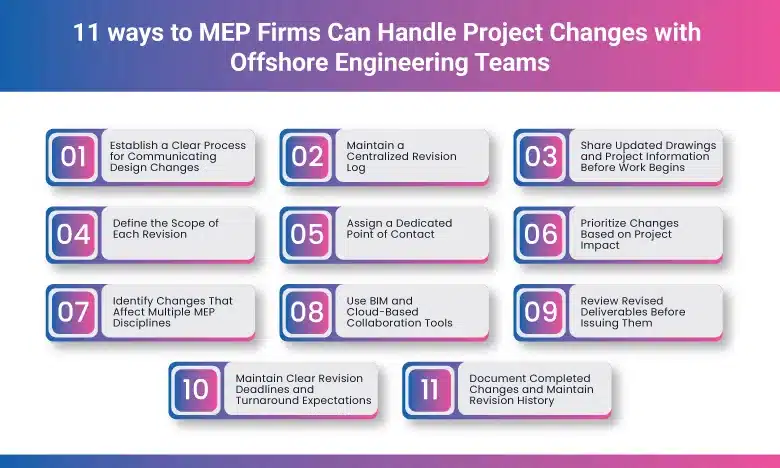
1. Establish a Clear Process for Communicating Design Changes
One of the biggest challenges when working with offshore engineering teams is ensuring that every project change is communicated clearly and reaches the right people.
Changes may come from the architect, client, contractor, or internal engineering review. If updates are communicated through scattered emails, messages, meetings, or marked-up drawings, important information can easily be missed.
MEP firms should establish a centralized communication process where all design changes are recorded and shared with the offshore team. Each revision should clearly explain what has changed, why the change is required, and which drawings or engineering systems are affected.
A structured communication process helps offshore engineers understand project updates without relying on assumptions or incomplete information.
2. Maintain a Centralized Revision Log
A revision log helps MEP firms and offshore engineering teams track changes throughout the project lifecycle.
Instead of relying only on email conversations, firms should maintain a revision record that includes:
- Revision number or reference
- Date the change was received
- Description of the requested change
- Drawings or systems affected
- Person responsible for reviewing the change
- Status of implementation
- Review and approval status
This allows both teams to understand which changes have been completed, which are pending, and which require additional clarification.
A centralized revision log also helps prevent the offshore team from working on outdated information.
3. Share Updated Drawings and Project Information Before Work Begins
Offshore engineering teams need access to the latest architectural drawings, structural backgrounds, equipment information, BIM models, specifications, and design requirements before implementing revisions.
If the offshore team receives an updated architectural layout but continues working with an older background, the revised MEP design may not align with the latest project information.
MEP firms should establish a process for sharing updated project files and clearly identifying the latest approved information.
Before assigning revision work, verify that:
- The latest architectural backgrounds are available.
- Relevant structural changes have been communicated.
- Updated equipment selections and specifications are shared.
- Previous markups and review comments are available.
- The revision scope is clearly identified.
Providing accurate project information helps offshore teams implement changes correctly and reduces unnecessary rework.
4. Define the Scope of Each Revision
Not every design change affects the entire MEP system. Some revisions may involve a single room, equipment location, or drawing detail, while others may require changes across multiple disciplines.
Before assigning revision work, MEP firms should clearly define the scope of the change.
For example, moving a mechanical unit may affect HVAC layouts, electrical connections, condensate drainage, structural coordination, and equipment access requirements.
The offshore team should understand whether the revision involves:
- A specific drawing or sheet
- A particular building area or floor
- One MEP discipline or multiple disciplines
- Design calculations or equipment selections
- BIM model updates
- Coordination with other trades
- Changes to previously issued deliverables
Clearly defined revision scope allows the offshore team to estimate the effort, identify dependencies, and complete the work more efficiently.
5. Assign a Dedicated Point of Contact
When multiple engineers are involved in a project, design changes can become difficult to manage if instructions come from different people.
MEP firms should assign a dedicated project manager, engineer, or coordinator to communicate revision requirements with the offshore engineering team.
This person can:
- Consolidate comments from clients and architects.
- Review conflicting instructions before forwarding them.
- Clarify technical questions.
- Prioritize revision requests.
- Track progress and pending items.
- Review completed changes before submission.
Having a single point of contact reduces confusion and helps offshore teams receive consistent instructions throughout the project.
6. Prioritize Changes Based on Project Impact
Not all revisions have the same level of urgency. Some changes may be necessary before the next coordination meeting, while others can be addressed during a later design review.
MEP firms should prioritize revisions based on their impact on project schedules, design coordination, construction activities, and deliverable deadlines.
For example:
| Revision type | Priority |
|---|---|
| Changes affecting active construction | High |
| Changes affecting major equipment or system layouts | High |
| Changes required for an upcoming permit submission | High |
| Minor drafting corrections | Normal |
| Non-critical documentation updates | Scheduled |
Communicating revision priorities allows offshore teams to allocate resources appropriately and focus on the changes that have the greatest impact on project delivery.
7. Identify Changes That Affect Multiple MEP Disciplines
MEP systems are interconnected, so a revision in one discipline may affect work completed by another discipline.
For example, relocating HVAC equipment may require changes to electrical power connections, plumbing connections, drainage, controls, and coordination with architectural or structural elements.
When working with an offshore engineering team, MEP firms should identify these dependencies before assigning revision work.
A coordinated review helps determine:
- Which disciplines need to update their drawings.
- Whether previously completed work needs to be revised.
- Whether BIM coordination is required.
- Whether calculations or equipment selections need to be reviewed.
- Whether the revision affects other project deliverables.
Identifying cross-discipline impacts early helps prevent incomplete revisions and coordination problems later in the project.
8. Use BIM and Cloud-Based Collaboration Tools
BIM and cloud-based project collaboration platforms can help MEP firms manage revisions more efficiently when working with offshore engineering teams.
Shared project environments allow teams to access current models, review comments, coordination issues, and updated documents without relying on multiple disconnected file exchanges.
MEP firms can use these platforms to:
- Share the latest Revit models and project files.
- Track design comments and coordination issues.
- Review model changes.
- Maintain revision history.
- Share updated drawings.
- Coordinate work across different engineering disciplines.
However, using collaboration tools alone is not enough. Teams must also establish clear file management standards, access permissions, naming conventions, and revision procedures to ensure everyone is working with the correct information.
9. Review Revised Deliverables Before Issuing Them
After the offshore engineering team completes the requested changes, the MEP firm should conduct an internal review before issuing updated deliverables to the client, architect, contractor, or other project stakeholders.
The review should confirm that:
- All requested revisions have been incorporated.
- Drawings reflect the latest project information.
- Related MEP disciplines have been coordinated.
- Previous comments have been addressed.
- No unintended changes have been introduced.
- Drawing references, schedules, annotations, and details remain consistent.
- Deliverables meet the firm’s quality standards.
A defined review process helps MEP firms maintain responsibility for engineering quality while benefiting from offshore production support.
10. Maintain Clear Revision Deadlines and Turnaround Expectations
Project changes often arrive when deadlines are already tight. Without realistic turnaround expectations, offshore engineering teams may struggle to balance revision work with ongoing project assignments.
MEP firms should communicate the expected completion date, review deadline, and submission deadline for each revision request.
For larger revisions, it may be helpful to break the work into smaller milestones. For example, the team can first update the affected layouts, then complete cross-discipline coordination, and finally prepare revised drawings for review.
This approach gives MEP firms better visibility into progress and allows them to identify potential delays before they affect the overall project schedule.
11. Document Completed Changes and Maintain Revision History
Once revisions are completed and reviewed, the updated drawings and project files should be properly documented.
Maintaining revision history helps MEP firms understand what changed between previous and current submissions. It also supports internal reviews, client communication, coordination meetings, and future project updates.
The offshore team should follow the firm’s established documentation standards for revision clouds, revision numbers, drawing dates, and descriptions, wherever applicable.
Proper documentation ensures that all stakeholders can identify the latest deliverables and understand the changes made during each project phase.
Common Mistakes MEP Firms Should Avoid When Managing Offshore Revisions
Working with offshore engineering teams can be efficient, but certain mistakes can create unnecessary delays and rework.
Sending incomplete revision instructions: Unclear markups or missing project information can lead to incorrect updates.
Sharing outdated drawings: Working from old architectural or engineering backgrounds can create coordination problems.
Communicating changes through multiple channels: Scattered instructions make it difficult to track revision history.
Failing to identify cross-discipline impacts: Changes affecting HVAC, electrical, plumbing, and fire protection systems may be overlooked.
Not reviewing completed revisions: Issuing revised drawings without internal quality checks can introduce errors.
Ignoring revision priorities: Treating every change as equally urgent can affect critical project deadlines.
Avoiding these mistakes helps MEP firms create a more reliable workflow with offshore engineering teams.
How an Offshore MEP Engineering Partner Can Support Project Changes
A reliable offshore engineering partner can help MEP firms manage ongoing revisions, drawing updates, BIM modifications, coordination requirements, and documentation tasks during different project phases.
With clearly defined workflows and communication procedures, offshore teams can support:
- MEP drawing revisions and updates
- HVAC, electrical, plumbing, and fire protection drawing modifications
- Revit model updates
- BIM coordination and clash detection
- Construction document revisions
- Redline implementation
- Drawing quality checks
- Project documentation and drafting support
The key is to establish a working relationship where the offshore team understands the firm’s design standards, project requirements, revision procedures, and quality expectations.
At MVN Engineering, we support MEP engineering firms with MEP design, BIM modeling, drawing production, coordination, and project documentation. Our engineering team works with clients to support ongoing project requirements, including design updates and revisions, while helping firms manage workloads and project delivery demands.
Conclusion
Project changes are unavoidable in MEP engineering, but they do not have to create unnecessary delays, coordination issues, or rework.
MEP firms working with offshore engineering teams can manage revisions effectively by establishing clear communication channels, maintaining revision logs, sharing updated project information, defining revision scope, prioritizing changes, and implementing consistent review procedures.
A structured workflow helps internal and offshore teams stay aligned throughout the project lifecycle, maintain drawing accuracy, and deliver updated engineering documents more efficiently.
The success of offshore collaboration depends not only on engineering capabilities but also on how effectively both teams manage information, communication, responsibilities, and project changes.