
 4 min read
Introduction
Design firms are under constant pressure to deliver projects faster while maintaining accuracy, coordination, and quality. As project volumes increase, many architecture, engineering, and construction companies face a common challenge: their internal teams do not always have enough time to complete Revit modeling and BIM production work within deadlines.
Revit outsourcing has become a practical solution that allows design firms to extend their production capacity without increasing permanent staff.
By working with experienced BIM teams, firms can reduce modeling time, manage peak workloads, accelerate project delivery, and allow their in-house professionals to focus on higher-value design and coordination activities.
What Is Revit Outsourcing?
Revit outsourcing is the practice of hiring an external BIM team or modeling partner to complete Revit-based project work.
Instead of assigning all modeling tasks to internal staff, design firms outsource specific production activities such as:
- Revit modeling
- CAD-to-Revit conversion
- PDF-to-Revit conversion
- BIM documentation
- Model cleanup
- Family creation
- Clash coordination support
- Construction documentation support
The outsourced team works according to the firm’s standards, templates, and project requirements.
Why Are Design Firms Outsourcing Revit Modeling?
The main reason firms outsource Revit work is not simply cost reduction. The bigger challenge is capacity.
Many design firms experience:
- Too many active projects
- Tight submission deadlines
- Limited BIM resources
- Difficulty hiring experienced Revit professionals
- Repetitive modeling workloads
- Project delays caused by production bottlenecks
Outsourcing provides additional modeling capacity when internal teams need support.
1. Faster Project Delivery
One of the biggest advantages of Revit outsourcing is faster turnaround.
A typical design workflow may require teams to spend significant hours creating:
- Floor plans
- Building models
- Views
- Sheets
- Families
- Documentation
An external Revit team can handle production tasks simultaneously, reducing the workload on internal designers.
For example:
An architecture firm receiving a large PDF drawing package for a commercial building may need a Revit model before starting design development.
Instead of delaying the project, the firm can outsource the conversion and modeling process.
2. Helps Manage Overflow Work
Design firms often do not need additional full-time employees permanently.
Their workload may change:
- A busy quarter with multiple projects
- A sudden deadline
- A large client submission
- A renovation project requiring existing-condition modeling
Revit outsourcing provides flexible support during these periods.
Instead of hiring and training new employees, firms can access additional BIM production resources when needed.
3. Allows Designers to Focus on Design
Many architects and engineers spend valuable time on repetitive modeling tasks.
Examples:
- Creating basic walls and floors
- Converting drawings
- Setting up views
- Preparing models
While these activities are necessary, they may not require senior designers.
Outsourcing production work allows internal teams to focus on:
- Design decisions
- Client coordination
- Engineering review
- Project management
- Quality control
4. Reduces Revit Production Bottlenecks
A common challenge in BIM workflows is that modeling becomes a project bottleneck.
For example:
The design is approved, but the Revit model is behind schedule.
Or:
The engineering team is ready, but architectural backgrounds are not complete.
A dedicated Revit outsourcing partner can help keep different project stages moving.
5. Access to Skilled BIM Resources
Experienced outsourcing teams often work across multiple project types, including:
- Commercial buildings
- Residential projects
- Healthcare facilities
- Educational buildings
- Industrial projects
They are familiar with:
- Revit standards
- BIM coordination processes
- Model organization
- LOD requirements
- Documentation workflows
This allows firms to scale without spending months recruiting and training.
Common Revit Outsourcing Services Used by Design Firms
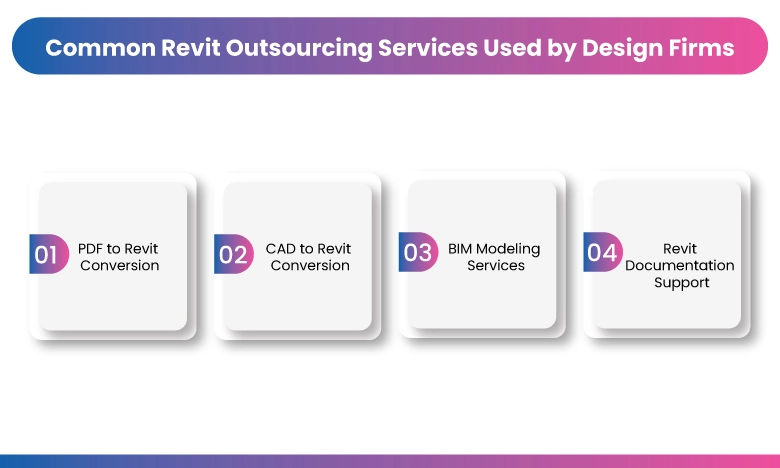
PDF to Revit Conversion
Converting existing PDF drawings into editable Revit models.
Common uses:
- Existing building documentation
- Renovation projects
- Client-provided drawings
- Legacy documentation
CAD to Revit Conversion
Transforming 2D CAD files into BIM-ready models.
Benefits:
- Better coordination
- 3D visualization
- Improved project collaboration
BIM Modeling Services
Creating structured Revit models from BIM Modeling design.
Includes:
- Architectural modeling
- MEP modeling
- Structural modeling
- Coordination models
Revit Documentation Support
Helping firms prepare:
- Plans
- Sections
- Elevations
- Views
- Construction documentation
Revit Outsourcing vs Hiring More BIM Staff
Many firms compare outsourcing with hiring additional employees.
Hiring In-House
Advantages:
- Direct team control
- Long-term employee development
Challenges:
- Recruitment time
- Training costs
- Fixed overhead
- Limited flexibility
Revit Outsourcing
Advantages:
- Faster access to resources
- Flexible project support
- Ability to scale during busy periods
- Reduced production pressure
The right choice depends on project volume, internal capability, and long-term business needs.
How to Choose a Revit Outsourcing Partner
Before selecting a BIM partner, design firms should evaluate:
Revit Experience
Check whether the team understands:
- Revit workflows
- BIM standards
- Project requirements
Quality Control Process
A reliable partner should have:
- Model checking procedures
- Review workflows
- Quality assurance steps
Communication Process
Important factors:
- Clear communication channels
- Regular updates
- Defined deliverables
Data Security
Firms should confirm:
- File handling procedures
- Access controls
- Confidentiality practices
The Future of Revit Outsourcing
As building projects become more complex, BIM workflows continue to become essential for collaboration between architects, engineers, and contractors.
Revit outsourcing is evolving from simple modeling support into a broader project delivery partnership.
Many design firms now use external BIM teams as an extension of their internal capabilities.
Conclusion
Revit outsourcing helps design firms reduce modeling time by providing additional BIM production capacity, improving project turnaround, and reducing internal workload.
For firms managing multiple projects, tight deadlines, or limited BIM resources, an experienced Revit outsourcing partner can provide the flexibility needed to deliver projects efficiently.
The goal is not to replace internal teams, it is to help them work faster, manage more projects, and focus on higher-value design work.