
 5 min read

Introduction
Quality control is one of the most important factors influencing the success of an MEP project. While project schedules and budgets often receive significant attention, poor-quality engineering deliverables can create far greater challenges, including permit review comments, design revisions, coordination conflicts, construction delays, and client dissatisfaction.
For MEP design firms, architects, and project owners, quality control is not simply about finding drafting errors. A well-defined quality control process helps ensure that designs comply with applicable codes, align with project requirements, coordinate across disciplines, and support smoother permit approvals.
This article explains how quality control processes improve MEP project outcomes and why firms that invest in structured QA/QC procedures consistently achieve better results.
What Is Quality Control in MEP Engineering?
Quality control (QC) is the systematic review of engineering deliverables to verify that drawings, calculations, specifications, and models meet project requirements before submission.
In MEP engineering, quality control typically includes:
- Design reviews
- Code compliance checks
- Drawing coordination reviews
- Calculation verification
- BIM clash detection
- Construction document reviews
- Permit submission reviews
The objective is to identify issues before they reach architects, owners, contractors, or permitting authorities.
Why Quality Control Matters in MEP Projects
MEP systems are highly interconnected. A single design issue can impact multiple disciplines and create downstream problems during construction.
Common consequences of inadequate quality control include:
- Permit review comments
- Design revisions
- Coordination conflicts
- Construction change orders
- Increased RFIs
- Delayed project approvals
- Reduced client confidence
A structured QC process reduces these risks and improves overall project performance.
How Quality Control Improves Permit Approval Success
One of the most valuable benefits of quality control is improved permit approval performance.
Building departments review MEP drawings for:
- Code compliance
- Life safety requirements
- Energy code compliance
- Equipment sizing
- Ventilation requirements
- Electrical load calculations
- Plumbing system design
Incomplete or inconsistent documents often generate review comments that require resubmission.
A thorough quality control process helps verify:
- Drawing completeness
- Required calculations
- Code references
- Equipment schedules
- Coordination between plans and specifications
As a result, firms can reduce permit review comments and improve first-pass approval rates.
How Quality Control Improves Code Compliance
Code compliance is one of the most critical aspects of MEP design.
Projects may require compliance with:
- NEC
- IMC
- IPC
- IECC
- ASHRAE standards
- Local jurisdiction amendments
Without a formal review process, code-related issues can remain undetected until permit review.
Quality control procedures help engineering teams verify:
- Ventilation requirements
- Equipment clearances
- Electrical sizing
- Energy compliance
- Plumbing fixture calculations
- Life safety requirements
Early code verification reduces costly revisions later in the project lifecycle.
How Quality Control Reduces Coordination Issues
MEP projects require close coordination between:
- Mechanical systems
- Electrical systems
- Plumbing systems
- Architectural disciplines
- Structural disciplines
Coordination problems often result in:
- Rework
- Field conflicts
- Construction delays
Quality control reviews identify conflicts before construction documents are issued.
Examples include:
- Ductwork interfering with structural elements
- Equipment room clearance issues
- Electrical service conflicts
- Plumbing routing conflicts
Early identification improves constructability and reduces project risk.
The Role of BIM in MEP Quality Control
Modern MEP projects increasingly rely on BIM workflows to improve quality.
BIM-based quality control can include:
- Clash detection
- Model coordination
- Equipment validation
- Clearance verification
- Constructability reviews
When combined with engineering reviews, BIM helps identify issues that may not be visible in traditional 2D documentation.
This contributes to more accurate construction documents and improved project coordination.
Essential Components of an Effective MEP Quality Control Process
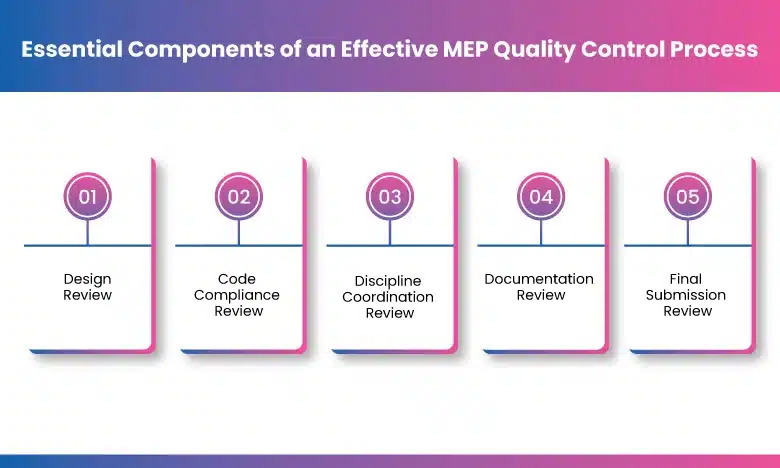
High-performing MEP firms often use a multi-stage review process.
1. Design Review
Verification of engineering concepts, calculations, and system selection.
2. Code Compliance Review
Review against applicable building, mechanical, electrical, plumbing, and energy codes.
3. Discipline Coordination Review
Verification that all disciplines work together without conflicts.
4. Documentation Review
Checking drawing accuracy, consistency, schedules, notes, and specifications.
5. Final Submission Review
Comprehensive review before permit submission or client delivery.
This layered approach significantly reduces the likelihood of errors reaching the next project phase.
Common Quality Control Mistakes in MEP Projects
Many firms perform reviews but still experience recurring quality issues.
Common mistakes include:
- Relying on a single reviewer
- Reviewing drawings without checking calculations
- Skipping code compliance verification
- Inadequate BIM coordination
- Lack of standardized review checklists
- Inconsistent QA/QC procedures between projects
Addressing these issues can substantially improve project outcomes.
MEP Quality Control Checklist
Before issuing construction documents, engineering teams should verify:
- Equipment schedules match drawings
- Load calculations are complete
- Code references are current
- Plans and specifications are coordinated
- BIM clash detection is completed
- Mechanical, electrical, and plumbing systems are coordinated
- Notes and details are consistent
- Permit submission requirements are satisfied
- Drawing revisions are incorporated correctly
- Final peer review is completed
How MEP Firms Can Strengthen Their QA/QC Process
To improve project quality, firms like MVN Engineering should:
- Develop discipline-specific review checklists
- Establish formal peer review procedures
- Perform code compliance reviews early
- Use BIM coordination tools
- Standardize quality documentation
- Track recurring review comments
- Continuously update code knowledge
A proactive approach to quality control creates measurable improvements in project delivery and client satisfaction.
Conclusion
Quality control is far more than an administrative review step. It is a critical engineering process that directly affects code compliance, permit approval success, project coordination, and construction outcomes.
For MEP firms, a structured quality control framework helps reduce design errors, minimize revisions, improve first-pass permit approvals, and strengthen client confidence. As project complexity continues to increase, firms that prioritize QA/QC processes are better positioned to deliver consistent, high-quality engineering solutions.
By integrating design reviews, code compliance checks, BIM coordination, and final document verification into every project, MEP teams can significantly improve project outcomes while protecting their professional reputation.