
 6 min read
In architecture, engineering, and construction (AEC) workflows, redlines are meant to provide clarity, but too often, they create confusion instead. A senior project architect at a 40-person Denver firm recently spent four hours deciphering the meaning of “adjust per discussion” across 23 sheet markups. By Thursday, her production team implemented two different interpretations, requiring a complete rework cycle.
Ask any architect, engineer, or BIM manager, and the story repeats itself: redlines come in varying formats, levels of detail, and often contradictory instructions. This inconsistency triggers costly ripple effects throughout a project, affecting time, budget, and coordination efficiency, especially under compressed schedules and complex building systems.
In this article, we’ll explore why redline consistency matters, the hidden costs of inconsistent markups, why traditional workflows are failing, and how top AEC firms are modernizing their processes to improve clarity, efficiency, and project outcomes.
Why Redline Consistency Matters More Than Ever
Historically, the AEC industry has assumed that redlines will never be perfect. Different team members write in varying styles, sometimes rushed or outdated, and the common belief is that “production will figure it out.” While this approach may have been tolerable in smaller offices or slower projects, three macro shifts have made inconsistent redlines far riskier today:
1. Compressed Schedules and Higher Throughput Expectations: Owners and general contractors now expect faster turnaround and fewer revision cycles. Even a single misinterpreted redline can derail a tight project schedule.
2. Increased Technical Complexity: Modern projects involve intricate MEP systems, energy modeling, and stringent code requirements. A vague note like “shift duct” or “revise riser” can have unforeseen downstream implications without precise context.
3.Distributed and Remote Production Teams: Many firms rely on offshore or remote production teams in different time zones. Ambiguous markups, local idioms, or incomplete screenshots can create confusion, forcing repeated clarification cycles.
The Real Cost of Inconsistent Redlines
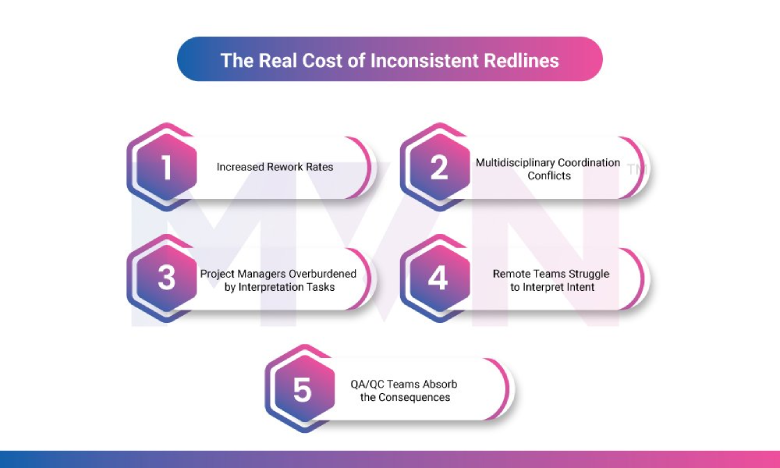
Many AEC leaders underestimate how deeply inconsistent redlines affect productivity and profitability. Production audits reveal several quantifiable impacts:
1. Increased Rework Rates
Poor markup clarity can increase rework in design teams by 20–35%, especially during late DD and CD phases. Causes include:
- Conflicting instructions from multiple reviewers
- Missing sheet references or unclear location annotations
- Ambiguous comments that require interpretation
For example, a 40-hour production workload can easily expand to 52 hours due to unclear redlines, directly reducing profit margins.
2. Multidisciplinary Coordination Conflicts
Inconsistent markups create downstream conflicts across architecture, structural, and MEP teams. Minor misinterpretations often escalate into issues that go unnoticed until late-stage coordination or construction administration phases.
3. Project Managers Overburdened by Interpretation Tasks
Project managers may spend 20–30% of their time deciphering redlines. Internal audits show that 40–50% of clarification requests stem from inconsistent formatting, fragmenting decision logs and creating risk during disputes or RFIs.
4. Remote Teams Struggle to Interpret Intent
Global production partners frequently encounter:
- Local idioms or jargon in markups
- Screenshots lacking reference levels
- PDFs with no hierarchical structure
- Hand sketches missing scale or elevation clues
These issues slow production velocity, increase stress, and create avoidable rework.
5. QA/QC Teams Absorb the Consequences
Quality assurance teams often correct errors introduced by unclear redlines:
- Ceiling coordination mismatches
- MEP routing conflicts
- Missing dimensions or incorrect datum points
- Repeated errors across multiple sheets
Each correction chips away at schedule buffers and staff morale.
Why Traditional Redline Workflows Are Failing
Despite digital tools, many firms still rely on a patchwork of:
- Handwritten markups
- Annotated PDFs
- Screenshots
- Informal chat messages
These methods are practical individually but fail as projects scale. Three recurring problems explain why clarity breaks down:
1. No Standard Markup Format – Each reviewer communicates differently, forcing production teams to interpret rather than execute.
2. Erosion of Version Control – Multiple PDF markups and comment threads circulate simultaneously, creating errors when outdated instructions slip through.
3. Lack of Formal Intake Processes – Drafters piece together instructions from scattered sources, resulting in unnecessary clarification cycles.
As firms grow, workflows that work for a 10-person studio falter with 40+ staff across shifts and time zones.
How Top AEC Firms Reduce Redline Inconsistencies
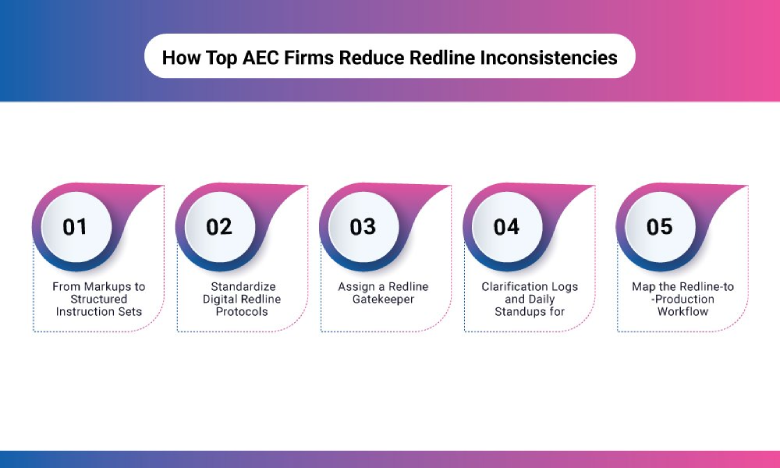
High-performing firms modernize redline management by building clarity, automation, and repeatability into the process.
1. From Markups to Structured Instruction Sets
Instead of vague comments, top firms create structured instructions that specify:
- Sheet references
- Affected views
- Spatial impact
- Required verification steps
This eliminates guesswork, reduces clarification cycles, and prevents RFI-like questions during CDs.
2. Standardize Digital Redline Protocols
Clear, non-negotiable standards prevent interpretation errors. Key elements include:
- Color-coded discipline-specific comments
- Mandatory context screenshots
- Update frequency rules in shared cloud environments like BIM 360 or Autodesk Construction Cloud
A short reference guide and spot checks ensure adoption. Tools like Bluebeam help firms enforce compliance efficiently.
3. Assign a Redline Gatekeeper
A single gatekeeper consolidates, filters, and organizes all markups before reaching production:
- Resolves contradictory instructions
- Removes duplicates
- Ensures clarity before execution
Firms report significant time savings and reduced rework through this role.
4. Clarification Logs and Daily Standups for Remote Teams
Structured communication protocols prevent ambiguity:
- Rolling clarification logs track questions, answers, and timestamps
- Daily standups (15–20 minutes) confirm intent and resolve ambiguous instructions
This maintains momentum and reduces delays across distributed teams.
5. Map the Redline-to-Production Workflow
Workflow mapping reveals bottlenecks and failure points. Typical stages:
- Redline creation
- Consolidation by gatekeeper
- Production execution and modeling
- QA/QC verification
- Final approval and issue
Mapping helps firms identify delays, reduce clarification requests, and improve efficiency.
The Future of Redline Management
Emerging practices include:
- AI-assisted structuring of reviewer comments to eliminate ambiguity
- Federated markup spaces for real-time cross-discipline coordination
- Upstream validation of redlines by production teams
These strategies clarify instructions upfront, reduce revision cycles, and are quickly becoming industry benchmarks.
How MVN Engineering Supports Firms with Redline Consistency
MVN Engineering helps AEC firms overcome costly workflow inefficiencies by:
- Implementing clarification logs and daily coordination protocols
- Proactively identifying unclear markups
- Streamlining PM communication
- Ensuring multidisciplinary awareness across architecture, structural, and MEP teams
- Standardizing markup formats and structured intake
Firms that invest in redline consistency immediately improve operational efficiency and gain a competitive edge as projects grow more complex.