
 5 min read
Project execution delays remain one of the most persistent challenges in the Architecture, Engineering, and Construction (AEC) industry. Despite advancements in technology and project management practices, many projects still experience schedule overruns, cost escalation, and repeated design revisions during construction.
What makes this issue particularly critical is that delays are often not caused by on-site execution alone. Instead, they originate much earlier in the design coordination phase, where architecture, structure, and MEP systems are not fully aligned.
As building systems become more complex and project timelines more aggressive, AEC firms must rethink how they approach coordination. This is where Building Information Modeling (BIM) has become a critical enabler of efficiency and predictability.
The Real Causes Behind Project Execution Delays
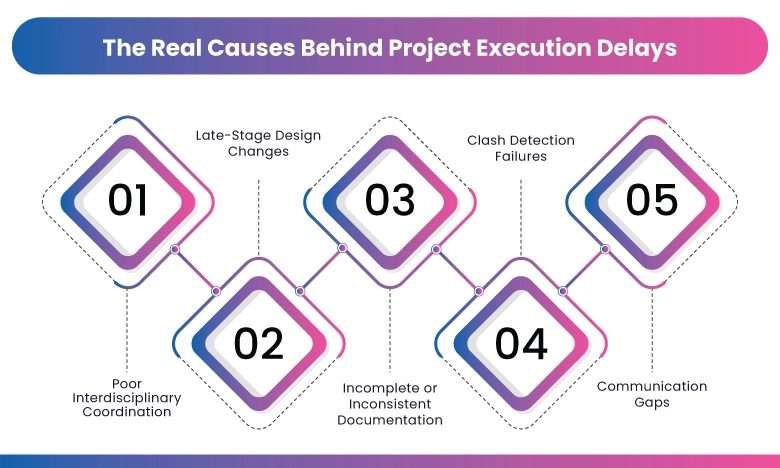
While every project is different, most execution delays can be traced back to a few recurring issues:
1. Poor Interdisciplinary Coordination
Architecture, structural engineering, and MEP systems are often developed in silos, leading to clashes discovered only during construction.
2. Late-Stage Design Changes
Design modifications during construction create a ripple effect of rework, approvals, and material delays.
3. Incomplete or Inconsistent Documentation
Missing details or mismatched drawings between disciplines lead to confusion on-site and RFIs from contractors.
4. Clash Detection Failures
Without early BIM coordination, conflicts between ducting, piping, beams, and architectural elements remain undetected until construction begins.
5. Communication Gaps
Inefficient communication between consultants, contractors, and design teams slows decision-making and approvals.
These challenges are not just technical; they directly impact project profitability, client satisfaction, and a firm’s reputation.
Why Traditional Coordination Methods Fail in Modern AEC Projects
Traditional coordination methods rely heavily on 2D drawings, manual reviews, and sequential workflows. While these methods worked in simpler projects, they are no longer sufficient for today’s complex building systems.
The key limitations include:
- Lack of real-time visualization of design conflicts
- Difficulty in coordinating multiple disciplines simultaneously
- Higher dependency on manual error detection
- Delayed identification of constructability issues
As a result, many issues are discovered too late—during construction—when changes are expensive and time-consuming.
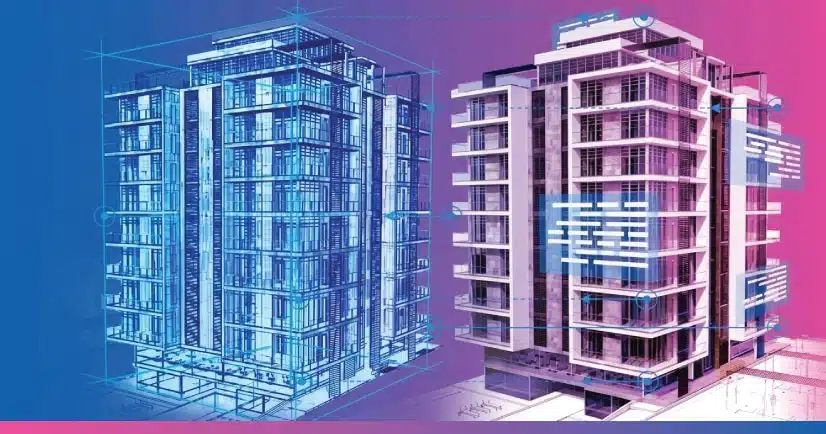
BIM addresses these limitations by creating a shared digital environment where all disciplines work within a coordinated model.
How BIM Reduces Project Execution Delays
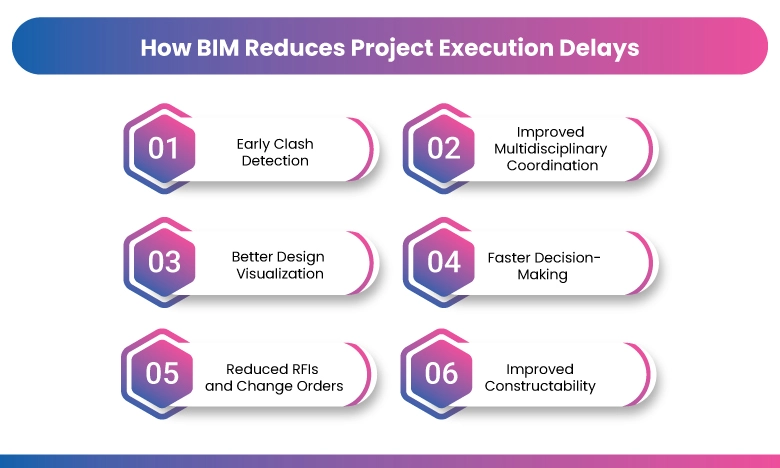
BIM transforms how AEC teams design, coordinate, and deliver projects by introducing a data-driven, collaborative workflow.
1. Early Clash Detection
BIM enables teams to identify conflicts between MEP systems, structural elements, and architectural components before construction begins. This significantly reduces on-site rework.
2. Improved Multidisciplinary Coordination
All stakeholders work within a centralized model, ensuring that design changes are instantly visible across disciplines.
3. Better Design Visualization
3D modeling improves understanding of spatial constraints, helping teams make faster and more accurate decisions.
4. Faster Decision-Making
With shared digital models, design reviews become more efficient and less dependent on lengthy manual coordination cycles.
5. Reduced RFIs and Change Orders
Clear and coordinated BIM models minimize ambiguity, reducing the number of contractor queries during construction.
6. Improved Constructability
BIM allows teams to simulate real-world conditions, ensuring that designs are practical and buildable.
Best Practices AEC Teams Should Follow to Avoid Execution Delays
To fully leverage BIM, AEC firms should adopt structured coordination practices:
Engage MEP Engineers Early
Early involvement of MEP engineers ensures systems are designed in harmony with architectural intent.
Define a BIM Execution Plan (BEP)
A well-defined BEP establishes workflows, responsibilities, and standards from project inception.
Conduct Regular Coordination Meetings
Frequent BIM coordination reviews help identify and resolve issues early.
Standardize Model Quality (LOD Requirements)
Defining Levels of Development ensures consistency and clarity across all design stages.
Implement QA/QC Processes
Quality checks at every stage reduce errors and improve final deliverable accuracy.
Maintain Clear Version Control
Proper documentation ensures all stakeholders are working on the latest model updates.
How MVN Engineering Helps AEC Firms Reduce Execution Delays
MVN Engineering helps AEC firms reduce project execution delays by strengthening BIM coordination and improving design accuracy before construction begins. Through well-structured BIM workflows, the team develops coordinated models across architecture, structure, and other disciplines to ensure all design components align early in the project lifecycle.
A key focus is early clash detection and resolution, where potential conflicts are identified in the BIM environment and resolved before they reach the construction stage. This helps significantly reduce RFIs, design revisions, and on-site rework that commonly cause delays.
MVN Engineering also supports BIM coordination across multiple stakeholders, ensuring consistent model standards, clear communication, and smooth integration of updates from different teams. In addition, their BIM models are developed with strong QA/QC processes and aligned to required Levels of Development (LOD), making them more reliable for construction use.
By providing scalable BIM support and maintaining high coordination standards, MVN Engineering enables AEC firms to improve collaboration, reduce errors, and deliver projects with greater speed and predictability.
Real Impact of BIM-Driven Coordination
When BIM is implemented effectively with experienced engineering support, AEC firms typically experience:
- Fewer design conflicts during construction
- Reduced RFIs and change orders
- Faster approval cycles
- Improved project predictability
- Lower rework costs
- Stronger client satisfaction
These improvements directly translate into higher profitability and better resource utilization for design firms.
Conclusion
Project execution delays are no longer just a construction-site problem they are a coordination challenge that begins at the design stage.
BIM provides AEC teams with the tools to identify issues early, improve collaboration, and enhance design accuracy. However, technology alone is not enough. The real impact comes from combining BIM with experienced engineering support and structured coordination workflows.
MVN Engineering helps AEC firms bridge this gap by delivering reliable BIM coordination, and scalable design support that reduces delays and improves project outcomes.
For firms looking to improve delivery timelines, reduce rework, and strengthen coordination across disciplines, adopting a BIM-driven approach supported by the right engineering partner is no longer optional; it is essential.