
 8 min read

Multifamily MEP design is one of the most critical factors in U.S. building permit approval. Across states like California, Texas, and New York, a large percentage of permit rejections occur due to errors in mechanical, electrical, and plumbing (MEP) design documentation.
These rejections often result in project delays, increased construction costs, and multiple redesign cycles during the plan check stage.
In most cases, the issue is not construction quality; it is poor coordination, incorrect load calculations, and non-compliance with U.S. building codes such as NEC, IMC, and IPC.
This article explains the most common MEP design mistakes that lead to permit rejection in multifamily projects and how these issues can be avoided through proper engineering and coordination.
Why MEP Design Plays a Critical Role in Permit Approval
MEP systems must comply with multiple codes and standards, including mechanical, electrical, plumbing, fire safety, and energy regulations. Permit reviewers evaluate whether the design meets all applicable requirements before granting approval.
Even minor errors in load calculations, ventilation design, or documentation can trigger revisions or rejection. Since MEP systems are interconnected, a mistake in one discipline often impacts others, making coordination essential.
For multifamily projects, where multiple units, shared systems, and complex layouts are involved, the risk of design errors increases significantly.
MEP systems are at the core of a building’s functionality, safety, and compliance. U.S. permitting authorities carefully review these systems to ensure they meet strict standards such as:
- National Electrical Code (NEC)
- International Plumbing Code (IPC)
- International Mechanical Code (IMC)
- Local energy and building regulations
Any inconsistency, missing information, or code violation in MEP design can quickly result in permit rejection.
Top MEP Design Mistakes That Cause Multifamily Permit Rejection in the U.S. (Plan Check Issues Explained)
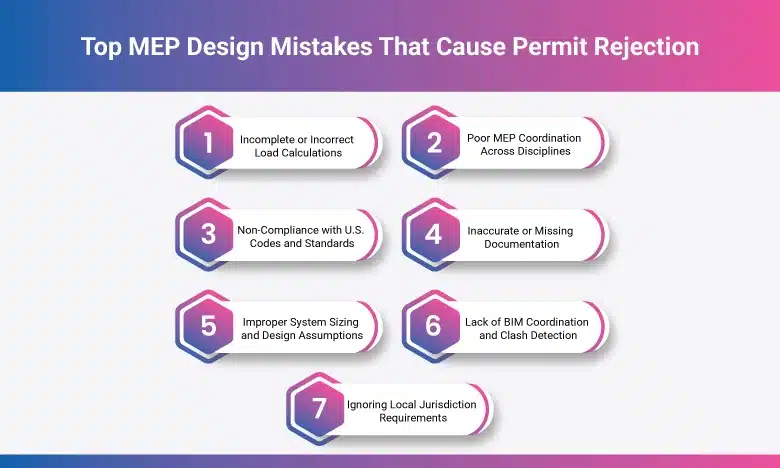
1. Incomplete or Incorrect Load Calculations
Accurate load calculations are the foundation of HVAC and electrical system design in multifamily projects. Permit reviewers closely evaluate whether the calculations reflect actual building conditions, occupancy patterns, and environmental factors. When these calculations are incomplete or incorrect, the entire system design becomes unreliable.
Common issues include:
- Incorrect occupancy assumptions
- Ignoring envelope heat gain
- Missing ventilation requirements
- Missing system layouts
- Incomplete annotations
- Conflicting information across plans
These gaps not only result in improperly sized systems but also make it difficult for reviewers to verify compliance with applicable codes and standards. As a result, permit applications are often returned with comments requiring recalculation and redesign.
2. Poor MEP Coordination Across Disciplines
MEP systems in multifamily buildings are highly interconnected, and lack of coordination between mechanical, electrical, and plumbing disciplines is one of the most common reasons for permit rejection.
Typical problems:
- Ductwork clashing with structural elements
- Piping conflicts with electrical conduits
- Mismatches between electrical load capacity
- Inconsistent routing layouts and lack of spatial planning further complicate the design
Without proper coordination, drawings appear fragmented and unbuildable. These conflicts are often identified during plan review or, worse, during construction, leading to delays, redesigns, and increased costs. Proper coordination ensures that all systems work together seamlessly within the building constraints.
3. Non-Compliance with U.S. Codes and Standards
Common compliance issues include electrical designs not aligned with NEC requirements, plumbing layouts that violate IPC guidelines, and HVAC systems that fail to meet IMC or ASHRAE standards. In addition, energy compliance requirements such as Title 24 or IECC are often overlooked or improperly documented.
Each discipline must adhere to specific codes, and even small deviations can cause issues.
Common problems & MEP designs that comply with U.S. codes such as:
- Electrical designs not aligned with NEC
- Plumbing layouts violating IPC guidelines
- HVAC systems that fail to meet IMC or ASHRAE standards
- Energy compliance requirements such as Title 24 or IECC
Permit reviewers are highly detail-oriented when it comes to code compliance. Missing or incorrect references to code provisions, improper calculations, or incomplete compliance documentation can lead to immediate rejection or multiple revision cycles.
4. Inaccurate or Missing Documentation
Permit approval heavily depends on the quality and completeness of submitted documentation. Even if the design is technically sound, incomplete or poorly presented documents can lead to rejection.
Common documentation issues:
- Missing schedules and specifications
- Incomplete system details
- Lack of energy compliance reports
- Incomplete drawings
- Unclear annotations
- Inconsistent information across drawings and documents further complicates the review process
Permit reviewers rely on clear, detailed, and well-organized documentation to verify compliance. When information is missing or unclear, it increases review time and often results in comments, resubmissions, and approval delays.
5. Improper System Sizing and Design Assumptions
A design may appear correct on paper but still fail during permit review if it is not practically constructible. Constructability is a critical factor that reviewers consider, especially in complex multifamily projects.
Issues include:
- Insufficient space for equipment installation
- Overdesign leading to energy inefficiency
- Underdesign causing performance failure
- Unrealistic routing of ducts and pipes
These problems indicate that the design has not been fully coordinated or validated for real-world execution. As a result, reviewers may flag the design for revision to ensure that it can be built as intended without conflicts or safety risks.
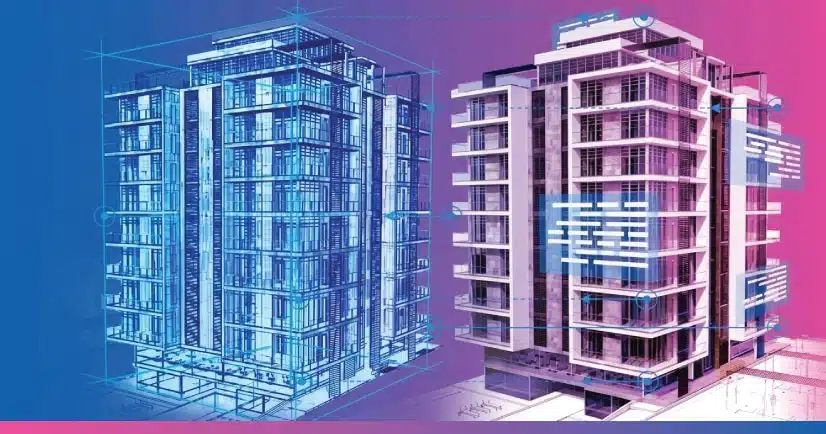
6. Lack of BIM Coordination and Clash Detection
Modern multifamily projects increasingly rely on BIM (Building Information Modeling) to ensure coordination and constructability. The absence of BIM-based coordination is a significant gap in many MEP designs.
- Conflicts remain unresolved
- Design appears uncoordinated
- Constructability issues arise
BIM coordination helps identify and resolve clashes early, ensures accurate spatial planning, and improves overall design quality. Many jurisdictions now expect coordinated, clash-free models as part of the submission process.
7. Ignoring Local Jurisdiction Requirements
While national codes provide a baseline, each state, county, or city may have its own amendments and additional requirements. Ignoring these local regulations is a common mistake that leads to permit rejection.
For example, California projects may require strict energy compliance under Title 24, while other jurisdictions may have specific ventilation, fire safety, or electrical standards. Failing to address these requirements during design results in non-compliant submissions.
Understanding and incorporating local jurisdiction requirements from the beginning is essential for smooth permit approval. It ensures that designs meet both national standards and local expectations, reducing the risk of revisions and delays.
Why MEP Designs Fail During Permit Review
Most multifamily permit rejections occur due to:
- Incorrect load calculations
- Poor MEP coordination
- Code compliance errors
- Incomplete documentation
These issues directly affect safety, constructability, and energy performance, which are key review criteria for approval.
How AEC Firms Can Avoid MEP Design Mistakes with the Right Design Support
Avoiding these challenges requires more than just technical knowledge; it demands consistent coordination, accuracy, and bandwidth.
Many AEC firms are now improving their outcomes by strengthening their MEP design process through:
- Early-stage coordination between disciplines
- Detailed quality checks before submission
- Ensuring up-to-date code compliance
- Maintaining complete and accurate documentation
In addition, having access to dedicated MEP design support can significantly reduce the risk of errors.
An extended design team can help:
- Manage workload during peak project phases
- Improve drawing accuracy and consistency
- Support faster turnaround times
- Ensure designs align with U.S. codes and standards
This approach allows AEC firms to maintain quality without overloading internal teams.
Benefits of Working with an Extended MEP Design Team
AEC firms that utilize extended MEP design support, such as that provided by MVN Engineering, often experience measurable improvements.
- Faster permit approvals
- Reduced rework and resubmission cycles
- Better coordination across disciplines
- Scalable support without the need for additional hiring
This flexibility is especially valuable for firms handling multiple multifamily projects simultaneously.
Conclusion
MEP design mistakes are one of the leading causes of multifamily permit rejection in the U.S. These issues are rarely due to isolated errors; they result from gaps in engineering, coordination, and compliance.
When proper MEP engineering practices are applied from the early stages, projects benefit from faster approvals, reduced costs, and smoother construction workflows.
For developers and architects, investing in high-quality MEP design is not just a technical requirement it is a critical factor in project success.