
 9 min read
Introduction
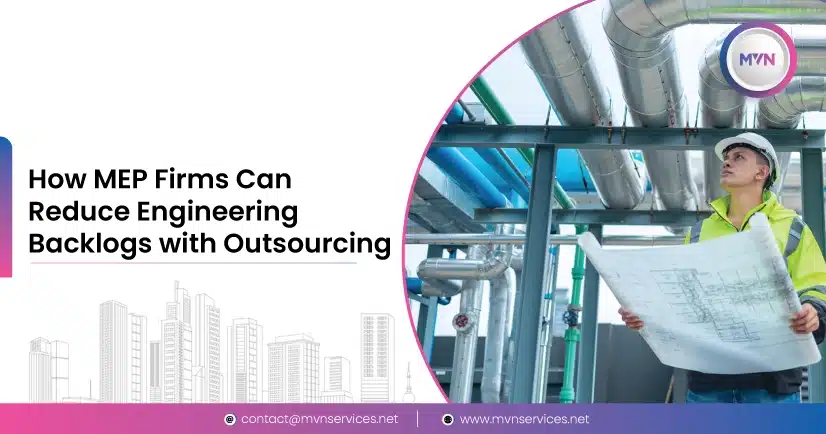
Engineering backlogs can make it difficult for MEP firms to manage project deadlines, respond to new opportunities, and maintain consistent design quality. When internal teams are handling multiple projects simultaneously, pending drawings, design revisions, and BIM modeling tasks can quickly accumulate.
MEP design outsourcing offers a way to increase production capacity without relying entirely on additional full-time employees. By assigning suitable design, drafting, modeling, and documentation tasks to an experienced engineering partner, firms can manage workloads more effectively while keeping engineering oversight within their established processes.
But outsourcing is not simply about transferring work to an external team. The real question is: Which tasks should an MEP firm outsource, how can quality be maintained, and how can outsourcing support a sustainable project workflow?
This guide explains how U.S. MEP firms can use outsourcing to manage engineering backlogs, evaluate suitable tasks, and establish an effective partnership with an offshore engineering team.
How Can MEP Firms Reduce Engineering Backlogs with Outsourcing?
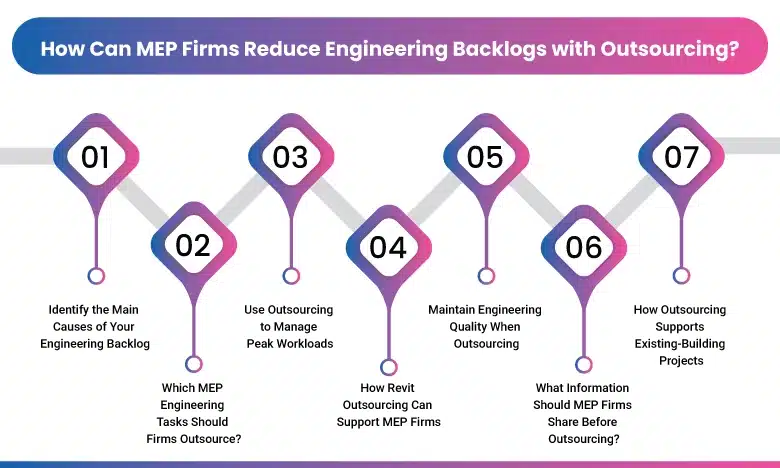
MEP firms can use outsourcing to support their internal teams by assigning appropriate engineering production and documentation tasks to an external partner.
The process typically involves:
- Identifying the source and size of the backlog.
- Separating tasks that require internal engineering decisions from suitable outsourced activities.
- Selecting an engineering partner with relevant technical capabilities.
- Establishing clear project requirements and deliverables.
- Coordinating work through defined review and communication processes.
- Monitoring quality, progress, and resource utilization.
The objective is not to outsource every engineering responsibility. Instead, firms can use external support where it fits their project requirements and internal workflow.
1. Identify the Main Causes of Your Engineering Backlog
Before outsourcing, MEP firms should understand why their project workload is accumulating. The right solution depends on whether the backlog is caused by insufficient staffing, inefficient processes, complex projects, or an increase in deliverable requirements.
Limited Internal Engineering Capacity
A firm may have enough engineers for its regular workload but struggle when multiple projects require attention at the same time.
For example, an MEP firm managing 10 active projects may receive several new assignments within the same month. Its existing team must divide time between design development, coordination, revisions, and documentation.
Hiring additional employees can be an option, but recruitment and onboarding take time. Outsourcing selected tasks can provide an additional resource when project demands exceed internal production capacity.
Repetitive Drafting and Modeling Work
MEP engineers often spend significant time on production activities, including:
- Preparing and updating drawings.
- Developing Revit MEP models.
- Incorporating design revisions.
- Creating construction documentation.
- Updating layouts based on engineering decisions.
- Supporting quantity takeoff and coordination tasks.
When these activities accumulate, engineers may have less time available for technical reviews and client communication.
Outsourcing suitable production work can help distribute these responsibilities.
Frequent Project Revisions
Design changes can increase the amount of work required after initial deliverables have been prepared.
Revisions may involve HVAC layouts, electrical plans, plumbing routing, equipment locations, or coordination updates.
An external team can support selected revision activities when it has the necessary project information, software capabilities, and clearly defined instructions.
2. Which MEP Engineering Tasks Should Firms Outsource?
Not every engineering task is equally suitable for outsourcing. MEP firms should evaluate each activity based on its technical complexity, required oversight, project standards, and professional responsibilities.
The following activities may be suitable for outsourcing, depending on the project scope and the partner’s capabilities.
| MEP Task | Potential Outsourcing Support |
| HVAC Design Support | HVAC layouts, drafting, modeling, and documentation support |
| Electrical Drafting | Electrical drawing production and design documentation support |
| Plumbing Design Support | Plumbing layouts, drafting, and model development |
| Fire Protection Drafting | Fire protection drawing and documentation support |
| Revit MEP Modeling | Development and updating of coordinated MEP models |
| BIM Coordination | Clash detection and coordination support |
| Construction Documentation | Drawing updates, sheet production, and revisions |
| Quantity Takeoff | Quantity extraction from drawings and models |
The exact scope should be agreed upon before work begins.
For projects requiring professional engineering services, the U.S. firm’s licensed professionals must retain appropriate responsibility for design decisions, review, and approval as required by applicable laws and project requirements.
What Should Stay with the Internal Engineering Team?
Some responsibilities may require direct involvement from the firm’s engineers, including:
- Engineering judgment and design decisions.
- Client discussions involving technical approvals.
- Professional engineering review and sealing, where required.
- Interpretation of project-specific requirements.
- Final responsibility for deliverables assigned to the firm.
Outsourcing can support these responsibilities, but it should not be presented as a replacement for the firm’s required professional oversight.
3. Use Outsourcing to Manage Peak Workloads
How Can MEP Firms Handle Temporary Increases in Project Volume?
MEP firms do not always experience consistent workloads throughout the year. Some periods may involve a large number of project submissions, while other periods may have fewer active assignments.
This variation can make resource planning difficult.
For example, an engineering firm may experience a busy period when several commercial renovation projects require simultaneous construction documentation. Its internal team may already be committed to other deadlines.
An outsourcing partner can support selected tasks during this period, subject to availability and agreed project requirements.
Example: Managing an Engineering Backlog
Consider a hypothetical MEP firm with the following pending tasks:
| Pending Work | Internal Situation |
| HVAC drawing revisions | Engineers occupied with client coordination |
| Revit model updates | Limited production capacity |
| Electrical documentation | Multiple projects approaching deadlines |
| Plumbing drawing updates | Waiting for available drafting resources |
The firm could evaluate which tasks are suitable for external support.
A possible workflow might include outsourcing selected Revit updates and drawing production while keeping engineering decisions and final review with the internal team.
The result depends on the actual workload, task allocation, team capabilities, and review process. Outsourcing does not automatically eliminate a backlog, but it can provide additional production resources.
4. How Revit Outsourcing Can Support MEP Firms
Revit is widely used in BIM-based building design workflows, and MEP firms may need to manage model development, updates, and coordination alongside engineering activities.
When internal engineers spend substantial time on model production, an experienced Revit outsourcing team may support selected modeling tasks.
Common Revit Support Activities
Depending on project requirements, outsourced teams may assist with:
- MEP Revit model development.
- Model updates based on approved design changes.
- HVAC, electrical, and plumbing modeling.
- Equipment and system representation.
- Model-based documentation.
- Clash detection support.
- Coordination-related model revisions.
How Does This Help Reduce Backlogs?
Consider a project where the engineering team has already established the design requirements, but the associated Revit model and documentation remain incomplete.
The firm may assign suitable modeling activities to an external team while its engineers focus on technical reviews and coordination.
This arrangement can help separate production tasks from engineering decision-making.
However, the model must follow the required project standards, level of development, coordination requirements, and client expectations.
5. Maintain Engineering Quality When Outsourcing
One of the most important questions for MEP firm decision-makers is:
How can we outsource engineering work without compromising quality?
The answer depends on the systems established before and during the project.
Establish Clear Deliverable Requirements
Before assigning work, define:
- Project scope.
- Required drawings and models.
- Applicable standards and specifications.
- File formats.
- Revit version, where relevant.
- Naming conventions.
- Expected submission dates.
- Revision procedures.
Clear requirements reduce ambiguity and help the external team understand what needs to be delivered.
Use a Defined Review Process
The internal engineering team should establish how outsourced deliverables will be reviewed.
The review process may include:
- Initial deliverable submission.
- Technical and documentation review.
- Identification of required corrections.
- Revision and resubmission.
- Final internal approval.
The specific review responsibilities depend on the project’s requirements and professional obligations.
Maintain Consistent Communication
Communication problems can lead to incorrect assumptions, rework, and delays.
MEP firms should establish:
- A designated point of contact.
- A method for sharing project information.
- A revision tracking process.
- A system for managing questions and clarifications.
- Regular progress updates.
These processes can help improve coordination between the internal engineering team and the outsourcing partner.
6. What Information Should MEP Firms Share Before Outsourcing?
A well-defined project brief helps the outsourcing team understand the scope and reduces avoidable clarification cycles.
Before starting, the MEP firm should provide the information available and relevant to the assigned work.
Project Information Checklist
| Information | Purpose |
| Architectural drawings | Understand building layout and spaces |
| Existing MEP drawings | Review available systems and conditions |
| Project specifications | Identify required technical and documentation standards |
| Design criteria | Understand the basis for assigned design work |
| Revit models | Support BIM-related activities |
| Equipment information | Coordinate relevant systems and components |
| Deliverable requirements | Define the expected output |
| Project schedule | Establish milestones and submission dates |
| Revision information | Identify the latest approved changes |
The information required will vary according to the project type and assigned scope.
For existing buildings, available documentation may be incomplete. The MEP firm should identify assumptions, survey information, and verification requirements before assigning work.
7. How Outsourcing Supports Existing-Building Projects
Existing-building projects can involve additional coordination challenges because the available documentation may not fully reflect current site conditions.
Examples include:
- Commercial renovations.
- Tenant improvement projects.
- Building system upgrades.
- Office remodeling.
- Retail renovation.
- Facility modifications.
MEP firms may need to work with existing drawings, field survey information, point clouds, or other available documentation.
How Can Outsourcing Help?
An outsourcing team may support selected activities such as:
- Converting available drawings into CAD or Revit.
- Developing existing-condition models.
- Updating MEP layouts.
- Preparing documentation based on approved design changes.
- Supporting coordination and drawing revisions.
The accuracy of the resulting deliverables depends on the quality of the source information, the assigned scope, and the verification process.
Outsourcing cannot replace required site verification or professional engineering judgment.
In-House vs. Outsourced Engineering Support
MEP firms may consider different staffing approaches based on project demand and operational requirements.
What Is the Difference?
| Factor | In-House Team | Outsourced Support |
| Team location | Internal organization | External engineering partner |
| Resource planning | Based on internal staffing | Based on agreed external capacity |
| Project control | Direct internal management | Requires coordination and review |
| Work allocation | Assigned within the firm | Defined through project scope |
| Staffing commitment | May involve ongoing employment costs | Depends on engagement structure |
| Communication | Internal workflows | Requires an agreed collaboration process |
Neither model automatically guarantees better project outcomes.
The appropriate approach depends on the firm’s staffing strategy, project pipeline, technical requirements, and ability to manage external collaboration.
Some firms may use a combination of internal engineers and external production support.
How MVN Engineering Supports U.S. MEP Firms
At MVN Engineering Services, we provide MEP design and BIM services for building projects, supporting engineering and design workflows through technical production and documentation services
Our service capabilities include:
- HVAC Design Services
- Electrical Design Services
- Plumbing Design Services
- Fire Protection Design Services
- MEP BIM Services
- Revit-based modeling and documentation
- BIM Clash Detection Services
- Quantity Takeoff Services
- Point Cloud to BIM Services
Conclusion
MEP engineering backlogs can create challenges for firms managing multiple projects, limited resources, and changing deliverable requirements.
MEP design outsourcing can provide additional support for suitable production, drafting, modeling, and documentation tasks. Its value depends on selecting appropriate work, establishing clear responsibilities, maintaining quality-control procedures, and coordinating effectively with the external team.
For U.S. MEP firms, the decision to outsource should be based on actual workload requirements rather than price alone.
A well-structured outsourcing partnership can become part of a firm’s resource-planning approach, helping it evaluate additional production capacity while maintaining its internal engineering and project management responsibilities.
If your firm is exploring MEP engineering outsourcing, the first step is to identify the tasks creating the greatest workload pressure and evaluate whether external support is appropriate for those requirements.