Introduction
Working with an offshore MEP engineering team can help U.S. MEP firms manage project workloads, increase production capacity, and support tight deadlines. However, outsourcing works best when both teams follow a clear and repeatable workflow.A successful offshore MEP workflow should define project responsibilities, information handoff, communication, design standards, quality checks, revisions, and final approvals from the beginning.This guide explains how U.S. MEP firms can build an effective workflow with offshore mep engineering teams while maintaining control over project quality and delivery.
What Is an Offshore MEP Engineering Workflow?
An offshore MEP engineering workflow is the structured process used by a U.S. MEP firm and an offshore engineering team to plan, produce, review, revise, and deliver MEP design work.A typical workflow includes:
- Project scope and requirement review
- Project information and file handoff
- Responsibility assignment
- Design and BIM production
- Internal QA/QC
- U.S. team review
- Revisions and coordination
- Final deliverable preparation
A defined workflow reduces confusion about who is responsible for each task and when work needs to be reviewed or approved.
Why Do U.S. MEP Firms Need a Structured Offshore Workflow?
Simply assigning design work to an offshore team does not automatically create an efficient process.Without a defined workflow, firms may experience:
- Missing project information
- Unclear responsibilities
- Repeated revisions
- Communication gaps
- Inconsistent drawing standards
- Coordination issues
- Delayed deliverables
- Quality-control problems
A structured workflow gives both teams a common process to follow throughout the project.
12 Steps to Build a Structured Workflow for U.S. MEP Firms and MEP Offshore Engineering Teams
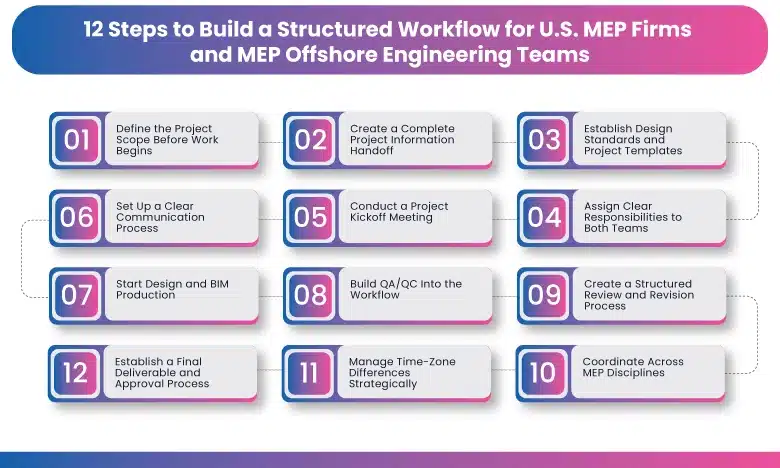
Step 1: Define the Project Scope Before Work Begins
The first step is to clearly define what the offshore engineering team will handle.The scope may include:
- HVAC design support
- Electrical design support
- Plumbing design
- Fire protection design
- Revit MEP modeling
- BIM coordination
- Shop drawings
- Construction documentation
- Quantity takeoffs
- Design revisions
- Existing-building documentation
The U.S. MEP firm should also define what remains under its own engineering responsibility.What should be included in the project scope?Clearly document:
- Project type
- Project location
- Design scope
- Required deliverables
- Project schedule
- Level of development
- Software requirements
- Drawing standards
- Client requirements
- Applicable project codes and standards
- Review and approval responsibilities
A clear scope gives the offshore team enough information to begin work without repeatedly requesting basic project details.
Before production begins, the U.S. MEP firm should provide the offshore team with the information required for the assigned work.Depending on the project, this may include:
- Architectural drawings
- Structural drawings
- Existing MEP drawings
- Site information
- Equipment schedules
- Design criteria
- Client standards
- Previous project documentation
- Revit models
- CAD files
- PDF drawings
- Point cloud data
- Redlines
- Project specifications
For renovation and existing-building projects, accurate existing-condition information becomes particularly important.What happens when project information is incomplete?The offshore team may have to make assumptions, stop work to request clarification, or produce work that later requires significant revisions.A project handoff checklist can help reduce these problems.
Step 3: Establish Design Standards and Project Templates
Every MEP firm has its own preferred way of producing drawings and models.Before production starts, provide the offshore team with the firm’s relevant standards.These may include:
- Revit templates
- CAD standards
- Naming conventions
- Sheet standards
- Annotation standards
- Layer standards
- Families
- View templates
- Worksharing requirements
- Model organization
- Drawing presentation standards
- Typical details
This helps the offshore team produce deliverables that fit naturally into the firm’s existing workflow.
Step 4: Assign Clear Responsibilities to Both Teams
One of the most important parts of an offshore workflow is defining who does what.A simple responsibility structure might look like this:
| U.S. MEP Firm | Offshore Engineering Team |
| Client communication | Design production support |
| Engineering direction | Revit/BIM modeling |
| Project requirements | Drawing development |
| Design decisions | Documentation support |
| Final engineering review | Internal QA/QC |
| Client comments | Revisions |
| Professional approval/sign-off where required | Coordination support |
The exact division depends on the project and the services being provided.The key is to establish responsibilities before production begins.
Step 5: Conduct a Project Kickoff Meeting
A kickoff meeting gives both teams an opportunity to confirm project requirements before work starts.The meeting should cover:
- Project scope
- Deliverables
- Schedule
- Design standards
- Responsibilities
- Communication channels
- Review process
- File-sharing process
- Revision procedure
- Important project risks
For larger projects, assigning a dedicated point of contact on each side can make communication more efficient.
Step 6: Set Up a Clear Communication Process
Communication should be planned rather than handled only when problems occur.U.S. MEP firms can establish:
- A primary project contact
- Regular progress meetings
- Design review meetings
- Shared issue trackers
- Comment logs
- Revision registers
- Task management systems
- Defined escalation procedures
Because U.S. and offshore teams may work in different time zones, firms can also establish overlapping working hours for important coordination discussions.The goal is not to have constant meetings. The goal is to make sure important project information reaches the right person at the right time.
Step 7: Start Design and BIM Production
Once scope, standards, responsibilities, and project information are confirmed, the offshore team can begin production.Depending on the agreed scope, this could involve:
- HVAC layouts
- Electrical layouts
- Plumbing layouts
- Fire protection drawings
- MEP Revit modeling
- Equipment placement
- Duct and piping layouts
- Electrical documentation
- BIM coordination
- Shop drawings
- Quantity takeoffs
The offshore team should work according to the agreed project standards rather than developing its own independent production method.
Step 8: Build QA/QC Into the Workflow
Quality control should happen throughout the workflow rather than only at the end.The offshore team can perform an internal QA/QC review before sending deliverables to the U.S. MEP firm.Checks may include:
- Drawing completeness
- Model consistency
- Naming standards
- Equipment information
- Dimensions
- Tags and annotations
- Sheet organization
- Coordination issues
- Design criteria
- Required deliverables
The U.S. MEP firm can then perform its engineering and project-level review before client submission.Why use two levels of review?A two-stage review can help identify production errors before they reach the final project review while keeping engineering responsibility and final approval with the appropriate U.S. professionals.
Step 9: Create a Structured Review and Revision Process
Design revisions are common in MEP projects.Instead of sending comments through multiple disconnected emails or messages, firms can use a structured revision process.A typical cycle is:U.S. MEP Firm Review → Consolidated Comments → Offshore Team Revision → Internal QA/QC → U.S. Review → FinalizationA comment tracker can record:
- Drawing/model location
- Comment
- Responsible person
- Priority
- Date assigned
- Revision status
- Completion date
This makes it easier to determine which comments are open, completed, or waiting for clarification.
Step 10: Coordinate Across MEP Disciplines
MEP systems cannot always be developed independently.HVAC, electrical, plumbing, and fire protection systems may need to coordinate with:
- Architectural layouts
- Structural systems
- Ceiling spaces
- Equipment rooms
- Shafts
- Roof systems
- Building penetrations
For BIM projects, model coordination and clash detection can help identify conflicts before construction.The workflow should therefore include defined coordination checkpoints rather than waiting until the end of the project.
Step 11: Manage Time-Zone Differences Strategically
Time-zone differences can become an advantage when the workflow is properly organized.For example, a U.S. MEP firm can provide comments toward the end of its workday, allowing the offshore team to work on those items during its working hours.The next U.S. workday can then begin with updated deliverables or completed revisions.This only works when:
- Comments are clearly documented
- Priorities are defined
- File access is reliable
- Responsibilities are clear
- Deadlines are realistic
Time-zone differences should be managed through the workflow rather than treated as a communication problem.
Step 12: Establish a Final Deliverable and Approval Process
Before final delivery, the project should pass through the agreed review process.The final workflow may include:
- Offshore production complete
- Offshore QA/QC complete
- U.S. MEP engineering review
- Coordination review
- Client comments addressed
- Final documentation
- Final approval/sign-off by the responsible professionals where required
The offshore team supports production and documentation, while final engineering decisions and professional approvals remain with the responsible U.S. professionals as applicable.
Common Problems in Offshore MEP Workflows
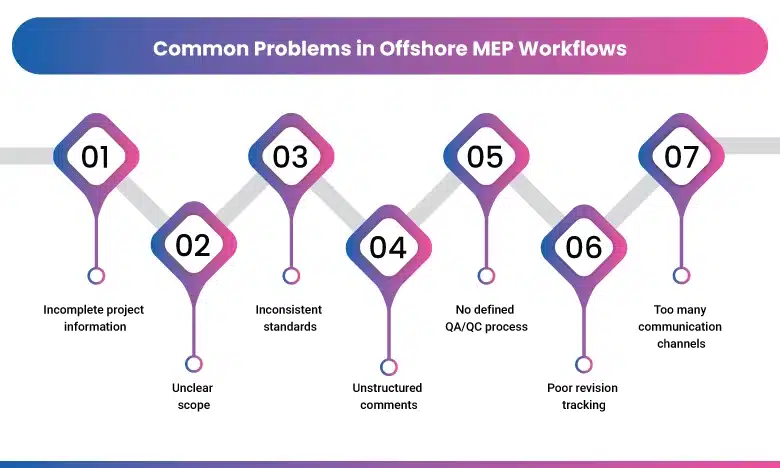
Even experienced firms can encounter workflow problems.
Missing drawings or specifications can delay production.
2. Unclear scope
If responsibilities are not defined, tasks can fall between teams.
3. Inconsistent standards
Different modeling or drafting methods can create additional review work.
Scattered feedback can lead to missed revisions.
5. No defined QA/QC process
Errors may reach the final review stage unnecessarily.
6. Poor revision tracking
Teams may accidentally work from outdated information.
7. Too many communication channels
Important project information can become difficult to track when it is spread across email, chat, calls, and separate documents.
How Can U.S. MEP Firms Improve Offshore Workflow Efficiency?
A few practical improvements can make the workflow more predictable:
- Use standardized project kickoff checklists
- Create project handoff templates
- Define responsibilities before production
- Provide company-specific Revit/CAD standards
- Use centralized project files
- Maintain a revision register
- Consolidate review comments
- Schedule regular coordination meetings
- Perform internal QA/QC before submission
- Track project milestones
- Maintain a single point of contact for each team
- Document important design decisions
The objective should be to create a repeatable workflow that can be used across multiple projects.
When Should an MEP Firm Consider Offshore Engineering Support?
Offshore engineering support can be considered when an MEP firm is experiencing:
- Temporary workload increases
- Project backlogs
- Tight documentation deadlines
- Revit modeling workload
- Repetitive drafting requirements
- Large numbers of revisions
- Multiple projects running simultaneously
- Difficulty expanding production capacity quickly
The decision should depend on project requirements, internal capacity, quality expectations, and the type of work that needs additional support.
What MEP Work Can Be Supported by an Offshore Team?
Depending on project requirements and the agreed scope, offshore teams can support:
- HVAC design and documentation
- Electrical design support
- Plumbing design support
- Fire protection design support
- MEP BIM modeling
- Revit MEP modeling
- CAD drafting
- Shop drawings
- Point cloud to BIM
- Clash detection
- Quantity takeoffs
- Design documentation
- Revision support
The U.S. MEP firm should determine which activities can be delegated while retaining appropriate engineering review and project control.
How MVN Engineering Supports U.S. MEP Firms
MVN Engineering Services provides
MEP design and
BIM support for projects handled by U.S. MEP firms.Our support can include:
- HVAC design support
- Electrical design support
- Plumbing design support
- Fire protection design support
- MEP BIM modeling
- Revit MEP services
- BIM coordination
- Clash detection
- Point cloud to BIM
- Shop drawing support
- Quantity takeoffs
- MEP drafting and documentation
Our workflow can be aligned with a client’s project requirements, software standards, deliverable expectations, review process, and communication structure.
Conclusion
An effective offshore MEP workflow is built around more than assigning work to a remote team. It requires clear scope definition, complete project handoff, consistent standards, defined responsibilities, structured communication, QA/QC, revision tracking, and final engineering review.When these processes are established from the beginning, U.S. MEP firms can integrate offshore engineering support into their existing project workflows while maintaining visibility and control over project delivery.

 10 min read