9 min read

Introduction
Expanding service offerings can create new business opportunities for MEP engineering firms. Clients increasingly look for engineering partners who can support multiple project requirements, coordinate different disciplines, and provide reliable project delivery.
However, expanding services often comes with additional expenses. Hiring specialized engineers, purchasing software licenses, providing training, managing additional resources, and increasing office capacity can significantly raise operational costs.
For small and mid-sized MEP firms in the United States, these expenses can make business expansion difficult, particularly when project demand is unpredictable.
The solution is not necessarily to build a larger in-house team for every new service. MEP firms can expand their capabilities through better resource planning, strategic partnerships, outsourcing, and improved internal workflows.
In this article, we explore practical ways MEP engineering firms can expand their service offerings while keeping operational costs under control.
Why Do MEP Firms Need to Expand Their Service Offerings?
Clients often prefer working with engineering firms that can support multiple project requirements through a coordinated approach.
For example, an architecture firm may initially need HVAC design support but later require electrical, plumbing, fire protection, or BIM services for the same project.
If an MEP firm cannot support these additional requirements, the client may approach another engineering provider.
Expanding service capabilities can help MEP firms:
- Respond to a wider range of client requirements.
- Create additional revenue opportunities.
- Strengthen relationships with existing clients.
- Compete for more comprehensive project scopes.
- Reduce dependency on a limited range of services.
- Build long-term business partnerships.
However, growth should be planned carefully. Adding services without evaluating operational requirements can increase overhead and reduce profitability.
8 Ways MEP Firms Can Expand Their Services Without Increasing Operational Costs
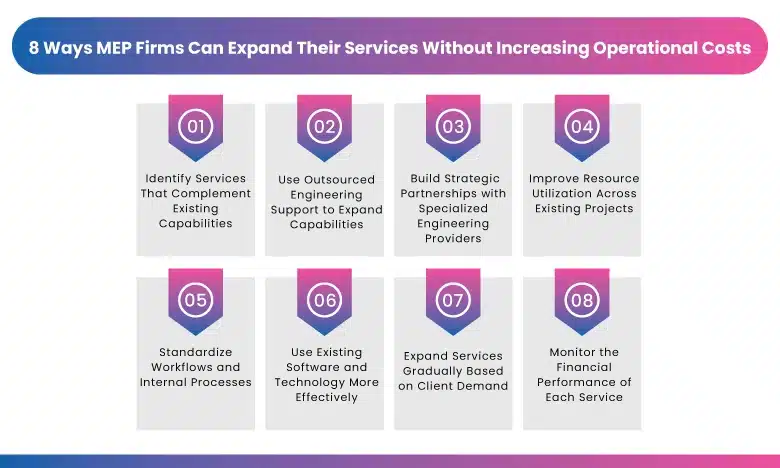
1. Identify Services That Complement Existing Capabilities
Before introducing a new service, MEP firms should evaluate their existing expertise and identify services that naturally complement their current offerings.
For example, a firm primarily providing HVAC design may receive requests for electrical design, plumbing design, or BIM support.
Instead of expanding into every available service, evaluate which additional capabilities are most relevant to existing clients.
Consider the following questions:
- What additional services do current clients frequently request?
- Which services are closely related to the firm’s existing expertise?
- Are there recurring project opportunities for these services?
- Can the firm support the additional work with its current resources?
- Would introducing the service create long-term business value?
This approach helps firms prioritize services based on actual client demand rather than investing in capabilities without a clear business opportunity.
2. Use Outsourced Engineering Support to Expand Capabilities
Building an in-house team for every engineering discipline can be expensive.
Recruitment, salaries, training, software licenses, and employee benefits create ongoing operational commitments, even when project demand fluctuates.
Working with an experienced outsourced engineering partner can help MEP firms access additional production and design support without immediately increasing their permanent workforce.
For example, an MEP firm with an established internal engineering team may use external support for:
- HVAC design and documentation.
- Electrical design support.
- Plumbing design and documentation.
- Fire protection design support.
- MEP BIM modeling.
- BIM coordination and clash detection.
- Shop drawings and drafting.
- Quantity takeoffs.
The internal team can continue managing client relationships, project requirements, engineering decisions, and reviews while the external team supports assigned project tasks.
This model gives firms more flexibility when exploring additional services or handling increased workloads.
However, outsourcing should be evaluated based on project requirements, partner capabilities, quality expectations, and total costs. It does not automatically guarantee lower operating expenses.
3. Build Strategic Partnerships with Specialized Engineering Providers
MEP firms do not need to develop every specialized capability internally.
Strategic partnerships with experienced engineering providers can help firms respond to project requirements that fall outside their existing service offerings.
For example, an MEP firm may have strong HVAC and electrical capabilities but limited internal resources for plumbing design or BIM production.
Instead of recruiting an entirely new team, the firm can establish a working relationship with a qualified external provider.
A successful partnership should include:
- Clearly defined service responsibilities.
- Agreed project deliverables.
- Established communication procedures.
- Consistent documentation standards.
- Quality review requirements.
- Clear pricing and commercial terms.
The right partnership can help MEP firms offer broader services while keeping their internal operations focused on their core strengths.
4. Improve Resource Utilization Across Existing Projects
Sometimes, MEP firms already have sufficient engineering capabilities but struggle to use their resources efficiently.
Engineers may be assigned to multiple projects without clear workload planning. Some team members may experience heavy workloads while others have limited assignments.
Before expanding the workforce, firms should review how existing resources are being utilized.
Practical improvements include:
- Tracking employee workloads across active projects.
- Assigning tasks based on individual expertise.
- Identifying recurring workflow bottlenecks.
- Planning resources around project milestones.
- Avoiding unnecessary duplication of work.
- Reviewing project capacity before accepting new assignments.
Better resource planning can help firms manage additional projects with their existing workforce before committing to higher fixed costs.
5. Standardize Workflows and Internal Processes
As MEP firms introduce additional services, project management can become more complicated.
Different teams may follow different documentation procedures, file structures, communication practices, and review methods.
Without consistent workflows, firms may spend more time correcting errors, clarifying responsibilities, and managing project information.
Establishing standard operating procedures can help reduce these inefficiencies.
Consider standardizing:
- Project onboarding procedures.
- Design and documentation guidelines.
- Drawing review and approval processes.
- File naming and revision management.
- Client communication procedures.
- Project handover requirements.
- Quality control checklists.
Standardized workflows help internal and external teams follow consistent expectations across different services.
They also make it easier to introduce new capabilities without creating unnecessary administrative work.
6. Use Existing Software and Technology More Effectively
Adding new services does not always require purchasing an entirely new set of software tools.
Before investing in additional technology, MEP firms should evaluate their existing software licenses, project management systems, and collaboration tools.
For example, firms using Autodesk Revit may already have a foundation for expanding their BIM-related services, depending on their licenses, team expertise, and project requirements.
Other opportunities include:
- Using shared project management platforms.
- Improving document management procedures.
- Creating reusable project templates.
- Standardizing BIM workflows.
- Using automated reporting where appropriate.
- Reducing duplicate software subscriptions.
The objective is to make better use of existing technology before introducing additional operational expenses.
7. Expand Services Gradually Based on Client Demand
Introducing multiple new services at once can increase operational complexity and financial risk.
A more practical approach is to expand gradually.
MEP firms can begin by evaluating demand from existing clients and selecting one additional service with clear business potential.
For example:
Stage 1: Identify demand
Review existing client requests and identify services that are frequently needed.
Stage 2: Evaluate delivery options
Determine whether the service can be delivered internally, through training, or with an external engineering partner.
Stage 3: Start with selected projects
Introduce the service through a limited number of projects and evaluate the delivery process.
Stage 4: Review performance
Measure project profitability, client feedback, delivery timelines, and resource requirements.
Stage 5: Expand gradually
Increase service capacity when demand and business results justify the expansion.
This approach allows firms to test new opportunities without making large upfront investments.
8. Monitor the Financial Performance of Each Service
Expanding service offerings is only valuable when the additional services contribute positively to business performance.
MEP firms should track the financial performance of each service rather than focusing only on revenue growth.
Important measurements include:
- Revenue generated by each service.
- Direct engineering and production costs.
- Outsourcing and software expenses.
- Project management and administrative costs.
- Time required to complete deliverables.
- Project profitability.
- Repeat business generated by the service.
For example, a new service may generate additional revenue but require extensive internal management and repeated revisions. After considering these costs, its actual profitability may be lower than expected.
Regular financial reviews help MEP firms identify which services deserve further investment and which require operational improvements.
Common Mistakes MEP Firms Should Avoid When Expanding Services
Expanding service capabilities without a clear strategy can create additional costs and operational challenges.
Here are some common mistakes to avoid:
1. Expanding without evaluating client demand: Introducing services without understanding market requirements can lead to underutilized resources.
2. Hiring before evaluating alternatives: Recruiting permanent employees for uncertain workloads can increase fixed expenses unnecessarily.
3. Offering too many services at once: Expanding too quickly can put pressure on existing teams and affect service quality.
4. Choosing partners based only on price: Low-cost providers may not meet the firm’s technical, communication, or documentation requirements.
5. Ignoring internal processes: Adding services without standardizing workflows can increase administrative work and project confusion.
6. Focusing only on revenue growth: Higher revenue does not always mean higher profitability. Firms should evaluate the complete cost of delivering each service.
How the Right Outsourced MEP Engineering Partner Supports Business Expansion
For MEP firms planning to expand their service offerings, an outsourced engineering partner can provide access to additional design and production capabilities.
However, the value of outsourcing depends on how well the external team integrates with the firm’s existing operations.
A suitable engineering partner should be able to:
- Support multiple MEP disciplines based on project requirements.
- Follow the firm’s established documentation standards.
- Work with the required engineering and BIM software.
- Coordinate with internal project teams.
- Manage assigned deliverables within agreed schedules.
- Support changing project workloads.
- Maintain consistent quality across projects.
The internal MEP firm can remain responsible for client relationships, project management, engineering oversight, and final approvals while the external team supports the agreed scope of work.
This arrangement can help firms explore additional services without immediately investing in a larger permanent workforce.
How MVN Engineering Helps MEP Firms Expand Their Capabilities
MVN Engineering Services provides MEP design and BIM support to engineering firms working on projects across the United States and Canada.
We understand that expanding service capabilities requires reliable engineering support, clear communication, and consistent project execution.
Our services include:
- MEP Design Services
- HVAC Design Services
- Electrical Design Services
- Plumbing Design Services
- Fire Protection Design Services
- MEP BIM Services
- BIM Coordination and Clash Detection
- Shop Drawings and Engineering Documentation
- Point Cloud to BIM
- Quantity Takeoff
Our team works with client-specific project requirements and established documentation standards to support engineering firms with their project workloads.
Whether your firm needs additional production capacity, support across multiple MEP disciplines, or BIM services for upcoming projects, MVN Engineering can help extend your existing engineering capabilities.
Looking to expand your MEP engineering capabilities without building every resource in-house? Connect with MVN Engineering to discuss your project requirements.
Conclusion
Expanding service offerings does not always require expanding the permanent workforce or increasing operational expenses.
MEP firms can explore new business opportunities through strategic partnerships, outsourced engineering support, better resource utilization, standardized workflows, and gradual service expansion.
The key is to understand client demand, evaluate the cost of delivering additional services, and select the right approach for each business requirement.
With a well-planned expansion strategy and dependable engineering support, MEP firms can broaden their capabilities, serve existing clients more effectively, and pursue new project opportunities while maintaining control over operational costs.