
 10 min read
Introduction
Texas continues to be a major market for construction, infrastructure development, commercial buildings, residential communities, and industrial projects. As project opportunities grow, MEP engineering firms across the state may find themselves managing more design assignments, tighter deadlines, and increasing client expectations.
For small and mid-sized MEP firms, accepting more projects often creates pressure on existing engineers. Hiring additional full-time employees may seem like the obvious solution, but recruitment, salaries, onboarding, software costs, and long-term commitments can make expansion challenging, particularly when workloads fluctuate.
Instead of increasing permanent headcount every time project demand rises, MEP firms can explore more flexible ways to manage engineering workloads. By improving resource planning, streamlining workflows, and working with reliable offshore engineering teams, firms can handle additional projects while maintaining control over quality, deadlines, and operational costs.
This article explores practical strategies Texas MEP firms can use to manage growing project workloads without expanding their in-house teams.
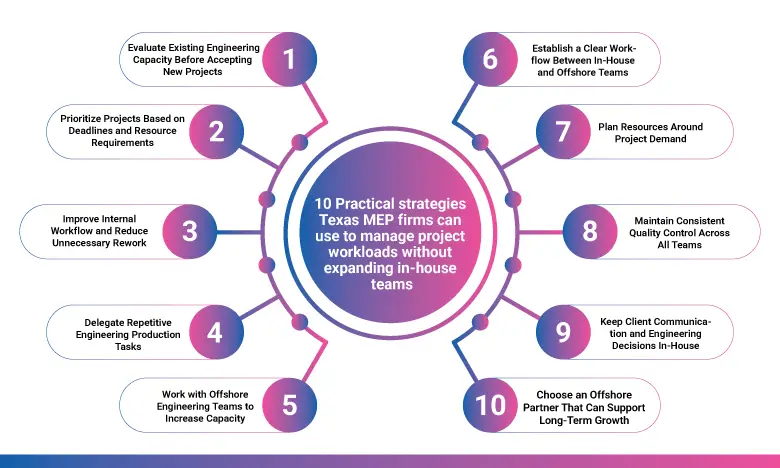
10 Practical strategies Texas MEP firms can use to manage project workloads without expanding in-house teams
1. Evaluate Existing Engineering Capacity Before Accepting New Projects
Before accepting additional projects, MEP firms should evaluate their current workload and available engineering resources. Understanding how much capacity the existing team has can help firm owners make better decisions about project commitments.
Instead of considering only the number of active projects, firms should assess the effort required for each assignment, including design development, drafting, coordination, revisions, client meetings, and quality reviews.
For example, a firm may have several engineers available, but if most of their time is committed to ongoing projects and client revisions, taking on additional work could affect delivery schedules.
MEP firms should regularly review:
- Current project deadlines and deliverables
- Engineer availability across different disciplines
- Pending revisions and coordination tasks
- Upcoming project start dates
- Internal review and approval requirements
- Workload distribution among team members
This helps firms identify workload bottlenecks before they begin affecting project delivery.
2. Prioritize Projects Based on Deadlines and Resource Requirements
When multiple projects are active simultaneously, not every task can receive the same priority. MEP firms need a clear system for organizing project work based on deadlines, client requirements, project complexity, and available resources.
Projects approaching submission deadlines may require immediate attention, while projects in early design stages may have more flexibility.
A structured prioritization process helps engineering teams focus on critical deliverables without unnecessarily interrupting other ongoing assignments.
MEP firms can categorize projects based on:
- Submission and milestone deadlines
- Client priorities
- Project complexity
- Required engineering disciplines
- Current project progress
- Available resources
Regular workload reviews help project managers identify which assignments need additional support and which can continue according to their existing schedules.
3. Improve Internal Workflow and Reduce Unnecessary Rework
Growing workloads can expose inefficiencies within existing engineering workflows. Repeated revisions, unclear instructions, incomplete project information, inconsistent documentation, and unnecessary review cycles can consume significant engineering time.
MEP firms should identify tasks that slow down project delivery and establish more consistent procedures for managing them.
Improving workflows may include:
- Standardizing project kickoff procedures
- Establishing drawing and documentation standards
- Organizing project files and revision records
- Clearly defining responsibilities for each project
- Improving communication between disciplines
- Creating consistent quality review checklists
Reducing unnecessary rework allows existing engineers to focus on higher-value engineering tasks rather than repeatedly correcting avoidable issues.
4. Delegate Repetitive Engineering Production Tasks
Not every task within an MEP project requires direct involvement from senior engineers or project leaders.
Experienced engineers often spend considerable time on drafting, model updates, drawing revisions, documentation, coordination tasks, and other production activities. Delegating suitable tasks can help internal teams focus on engineering decisions, client communication, technical reviews, and project management.
MEP firms should identify work that can be assigned to additional production resources without compromising their engineering standards.
Examples include:
- Revit modeling and drafting
- HVAC, electrical, and plumbing drawing production
- Redline implementation
- Drawing updates and revisions
- BIM coordination support
- Construction documentation
- Quantity takeoffs
- Revit family creation
Effective delegation helps firms utilize their existing engineers more efficiently while creating additional capacity for incoming projects.
5. Work with Offshore Engineering Teams to Increase Capacity
One of the practical ways Texas MEP firms can manage increasing workloads without expanding their permanent in-house teams is by working with offshore engineering partners.
An offshore team can provide additional production support when internal resources are occupied with multiple projects, deadlines, or revisions. Instead of recruiting full-time employees for every increase in workload, firms can assign suitable engineering and documentation tasks to an external team.
This approach can help MEP firms manage workload fluctuations while maintaining flexibility in resource planning.
Offshore engineering teams can support activities such as:
- Mechanical, electrical, and plumbing design production
- HVAC design and drafting
- Revit MEP modeling
- BIM coordination
- Construction drawings and documentation
- Design revisions and redline updates
- Quantity takeoffs
- Drawing quality checks
The internal team can continue managing client requirements, engineering decisions, project coordination, and final approvals, while the offshore team supports the production workload.
The success of this arrangement depends on selecting a partner who understands the firm’s standards, communication expectations, project requirements, and quality-control procedures.
6. Establish a Clear Workflow Between In-House and Offshore Teams
Adding offshore engineering resources without a defined workflow can create additional coordination challenges. To avoid this, Texas MEP firms should establish clear responsibilities and communication procedures before assigning project work.
The internal team should define project requirements, communicate design intent, provide the necessary backgrounds and specifications, and establish review procedures. The offshore team should understand the assigned scope, deliverables, deadlines, and documentation standards.
A typical workflow may include:
- Project requirements and scope are defined by the in-house team.
- Relevant drawings, specifications, and backgrounds are shared.
- Tasks are assigned with clear deliverables and deadlines.
- The offshore team completes the assigned engineering production work.
- Progress and technical questions are communicated regularly.
- Completed work is reviewed by the internal engineering team.
- Comments are addressed and final deliverables are prepared.
A consistent workflow helps both teams understand their responsibilities and reduces the time spent managing assignments.
7. Plan Resources Around Project Demand
Project workloads in engineering firms can fluctuate. A firm may experience a busy period with several projects starting simultaneously, followed by a period with fewer active assignments.
Maintaining a large permanent team to handle peak workloads may not always be practical. However, having too few resources during busy periods can create backlogs and affect client satisfaction.
MEP firms should develop resource plans based on expected project demand, upcoming milestones, and current team capacity.
Resource planning should consider:
- Expected project starts over the next few weeks or months
- Upcoming submission deadlines
- Current engineering workload
- Anticipated revisions
- Discipline-specific resource requirements
- Availability of external engineering support
Planning ahead allows firms to arrange additional production support before workloads become difficult to manage.
8. Maintain Consistent Quality Control Across All Teams
Managing growing workloads should not come at the expense of engineering quality. Whether work is completed internally or with offshore support, MEP firms must maintain consistent standards across all project deliverables.
A standardized quality-control process helps ensure that drawings, models, calculations, documentation, and revisions are reviewed before they are issued.
Firms should establish clear review procedures covering:
- Project-specific design requirements
- Drawing standards and templates
- Coordination between MEP disciplines
- Drawing completeness and consistency
- Revision accuracy
- Internal review comments
- Final deliverable approval
When offshore teams follow the same standards and review procedures as the internal team, firms can increase production capacity without creating inconsistent deliverables.
9. Keep Client Communication and Engineering Decisions In-House
Even when engineering production work is supported by offshore teams, Texas MEP firms should maintain direct control over client relationships, project decisions, and engineering responsibility.
Clients should have clear communication with the MEP firm regarding project scope, schedules, design changes, technical requirements, and deliverables.
The in-house team should remain responsible for:
- Understanding client requirements
- Managing project scope
- Communicating project updates
- Making engineering decisions
- Coordinating with architects and other stakeholders
- Reviewing deliverables
- Managing approvals and final submissions
This approach allows firms to use external engineering resources without losing control of the client experience or project direction.
10. Choose an Offshore Partner That Can Support Long-Term Growth
Not every outsourcing arrangement provides the same level of flexibility or reliability. Texas MEP firms should evaluate potential offshore partners based on their ability to support ongoing projects, understand established workflows, and maintain consistent quality.
Rather than focusing only on hourly rates, firms should evaluate:
- Relevant MEP engineering experience
- Familiarity with U.S. project requirements
- Revit and BIM capabilities
- Communication and responsiveness
- Quality-control procedures
- Ability to handle project revisions
- Resource availability
- Experience working with U.S. engineering firms
- Ability to follow client-specific standards
A reliable offshore partner should work as an extension of the firm’s production team, helping internal engineers manage workloads while maintaining project expectations.
Common Challenges Texas MEP Firms Should Avoid
When trying to manage increasing workloads without hiring additional employees, firms should avoid the following mistakes:
Accepting more projects without evaluating capacity: This can create unrealistic deadlines and put pressure on existing engineers.
Delegating without clear instructions: Incomplete information can lead to repeated revisions and unnecessary coordination.
Using external support only after projects become delayed: Arranging engineering support early is generally easier than addressing an existing backlog.
Failing to establish quality-control procedures: External work should follow the same standards as internally produced deliverables.
Overloading project managers: Additional engineering production capacity still requires effective project management and communication.
Treating outsourcing as a short-term emergency solution: A consistent working relationship can make resource planning and project handoffs more predictable.
Avoiding these challenges helps firms use additional engineering resources more effectively.
How MVN Engineering Supports Texas MEP Firms
MVN Engineering Services provides MEP design and BIM production support to engineering firms looking to manage project workloads more efficiently. Our team works with MEP firms to support ongoing projects, additional design assignments, documentation requirements, and project deadlines.
Our services include:
- Mechanical, electrical, and plumbing design support
- HVAC design and drafting
- Revit MEP modeling
- BIM coordination and clash detection
- Construction documentation
- Design revisions and redline updates
- Quantity takeoffs
- Revit family creation
By working with an experienced offshore engineering team, Texas MEP firms can add production capacity when needed, manage multiple projects more efficiently, and support business growth without immediately increasing their permanent in-house workforce.
Whether a firm needs support for a specific project, ongoing engineering production, or additional resources during busy periods, MVN Engineering can help provide flexible engineering support across Texas aligned with its project requirements and workflows.
Conclusion
Growing project workloads create opportunities for Texas MEP firms, but managing additional assignments with limited engineering resources can become challenging.
Rather than relying entirely on expanding their in-house teams, firms can improve resource planning, streamline workflows, delegate production tasks, and collaborate with offshore engineering partners.
With clear communication, defined responsibilities, consistent quality-control procedures, and reliable external support, MEP firms can manage more projects while maintaining engineering quality, client relationships, and delivery schedules.
Building a flexible engineering workflow allows firms to respond to changing project demand and pursue new opportunities without making every increase in workload a permanent staffing decision.