
 7 min read
Across the U.S. AEC (Architecture, Engineering, and Construction) industry, project complexity is increasing while delivery timelines are shrinking. MEP (Mechanical, Electrical, and Plumbing) design has become one of the most critical and often most overloaded parts of the construction workflow.
AEC firms today are facing a familiar set of challenges:
- Skilled MEP and BIM talent is expensive and hard to hire
- Project deadlines are becoming more aggressive due to fast-track construction
- Internal teams are overloaded with coordination and revisions
- Profit margins are under pressure due to rising overhead costs
Because of this, many firms are re-evaluating a core operational decision:
Should we continue expanding in-house MEP teams, or should we leverage offshore MEP design support as an extension of our team?
This blog provides a clear, practical comparison between in-house vs offshore MEP teams, specifically from an AEC workflow perspective covering cost, speed, quality, scalability, and real-world project impact.
Understanding In-House vs Offshore MEP Teams in AEC Workflows
In-House MEP Teams
An in-house MEP team consists of engineers, BIM modelers, and CAD technicians employed directly by your firm. They work closely with architects, structural engineers, and project managers, often in the same office environment.
Typical responsibilities include:
- MEP design development
- BIM modeling (Revit)
- Coordination with architecture and structure teams
- Construction documentation
This model provides strong control and real-time collaboration but comes with high fixed costs and limited scalability.
Offshore MEP Teams
Offshore MEP teams are external engineering resources located in cost-efficient regions such as India or Southeast Asia. They function as a remote extension of your in-house team and handle production-heavy tasks.
They typically support:
- Revit MEP modeling (LOD 300–500)
- Shop drawings and construction documents
- Clash detection and coordination
- Design development support
The key advantage is flexibility: firms can scale resources based on project demand without increasing permanent overhead.
What In-House MEP Drafting Typically Includes
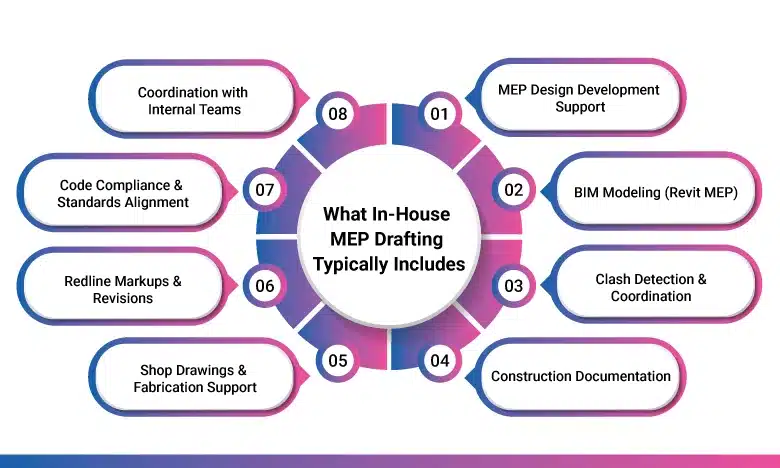
For AEC firms, in-house MEP drafting is more than just creating drawings; it’s a combination of design support, coordination, and documentation that directly impacts project execution.
An internal MEP drafting team typically handles the following:
1. MEP Design Development Support
- Assisting engineers with HVAC, electrical, and plumbing layouts
- Translating design concepts into detailed drawings
- Iterating designs based on internal reviews and client feedback
2. BIM Modeling (Revit MEP)
- Creating 3D models at various Levels of Development (LOD 100–300)
- Developing coordinated models with architectural and structural disciplines
- Maintaining model accuracy throughout project stages
3. Clash Detection & Coordination
- Identifying conflicts between MEP systems and other disciplines
- Using tools like Navisworks for clash detection
- Coordinating with architects and structural teams to resolve issues
4. Construction Documentation
- Preparing detailed MEP drawings for construction
- Generating plans, sections, and schematics
- Ensuring documentation aligns with project specifications
5. Shop Drawings & Fabrication Support
- Producing detailed shop drawings for contractors and fabricators
- Incorporating field conditions and installation requirements
- Supporting construction teams with accurate, build-ready drawings
6. Redline Markups & Revisions
- Updating drawings based on engineer markups
- Managing multiple revision cycles
- Ensuring all changes are accurately reflected
7. Code Compliance & Standards Alignment
- Ensuring designs follow U.S. standards such as:
- ASHRAE (HVAC)
- NEC (Electrical)
- NFPA (Fire Protection)
- Adapting drawings to local building codes and project requirements
8. Coordination with Internal Teams
- Daily collaboration with architects, engineers, and project managers
- Participating in coordination meetings
- Aligning drafting output with project timelines
Cost Comparison: The Real Impact on AEC Profitability
Cost is often the primary reason AEC firms explore offshore support but the real financial difference goes deeper than salaries alone.
In-House Cost Structure
Running an internal MEP team in the U.S. involves:
- High annual salaries for engineers and BIM specialists
- Employee benefits and insurance costs
- Recruitment, onboarding, and training expenses
- Software licensing (Revit, AutoCAD, Navisworks, BIM 360)
- Office space, infrastructure, and IT support
- Idle cost during low project utilization
Even when workload drops, these costs remain fixed.
Offshore Cost Advantage
Offshore MEP outsourcing replaces fixed costs with a flexible model:
- Lower hourly or project-based pricing
- No hiring or retention overhead
- No infrastructure or software investment
- Pay only for actual project requirements
- Easy scalability based on workload
Financial Impact for AEC Firms
In most cases, firms experience 40–60% cost savings compared to maintaining equivalent in-house capacity.
This directly improves:
- Project profitability
- Bid competitiveness
- Resource allocation efficiency
MEP Delivery Model Comparison: In-House vs Offshore vs MVN Engineering
| Aspect | In-House MEP Team (USA) | Typical Offshore MEP Team | MVN Engineering (Dedicated Offshore Partner) |
| Cost Structure | High fixed cost (salaries, benefits, overhead, software) | Lower cost but varies by vendor and quality level | Optimized cost with transparent project-based pricing |
| Scalability | Limited by hiring capacity | Scalable but often inconsistent resource availability | Fully scalable dedicated teams on demand |
| Turnaround Time | Dependent on internal workload | Faster than in-house, but may face coordination delays | Structured 24-hour workflow for faster delivery cycles |
| BIM Expertise (Revit MEP) | Strong but limited by team size | Varies widely between vendors | Specialized BIM MEP teams with consistent LOD delivery |
| Code Compliance (USA Standards) | Fully compliant | May vary depending on experience | Strong focus on ASHRAE, NEC, NFPA compliance |
| Quality Control (QA/QC) | Internal review process | Often inconsistent or minimal QC | Multi-stage QA/QC with structured review workflow |
| Communication | Instant (same office/time zone) | Time zone gap challenges | Overlap hours + dedicated project coordinators |
| Clash Detection & Coordination | Handled internally (resource heavy) | Sometimes outsourced or limited depth | Dedicated coordination team using Navisworks/BIM tools |
| Flexibility | Low flexibility during peak workload | Moderate flexibility | High flexibility with quick ramp-up/down support |
| Project Focus | Divided across internal workload | Shared resources across clients | Dedicated team per client/project for consistency |
When Should AEC Firms Choose Offshore vs In-House Teams?
Choose In-House When:
- You require constant on-site coordination
- Projects are small and repetitive
- You already have sufficient internal capacity
Choose Offshore When:
- Your internal team is overloaded
- You need faster delivery cycles
- You want to reduce operational costs
- You handle large or multiple concurrent projects
Conclusion
The decision between in-house and offshore MEP teams is no longer just about cost, it’s about efficiency, scalability, and competitiveness.
In today’s AEC environment:
- Projects are faster
- Clients expect quicker turnaround
- Margins are tighter
- Talent is harder to retain
Offshore MEP support is not a replacement for your team — it is a force multiplier that helps your firm deliver more with less.