8 min read

Managing multiple projects at the same time can be challenging for MEP engineering firms. Different project requirements, deadlines, team members, and documentation standards can make it difficult to maintain consistent quality across every project.
The challenge becomes greater when firms work with outsourced MEP engineering teams. Differences in workflows, communication practices, documentation methods, and quality expectations can lead to inconsistent deliverables if the teams do not follow a common process.
However, outsourcing does not have to mean compromising design consistency. With clearly defined standards, structured workflows, effective communication, and regular quality checks, MEP firms can integrate external engineering teams into their operations while maintaining control over project quality.
In this article, we explore how MEP firms can maintain consistent design standards across multiple projects while working with outsourced MEP engineering teams.
Why Design Consistency Matters for MEP Engineering Firms
For MEP engineering firms, consistency is important for more than producing drawings that look similar. It helps maintain the firm’s engineering standards, improve coordination, simplify internal reviews, and deliver predictable results to clients.
When different teams work on multiple projects without shared guidelines, firms may experience:
- Different drawing formats and documentation styles.
- Inconsistent naming conventions and Revit standards.
- Variations in layer organization and annotation methods.
- Repeated corrections during internal quality reviews.
- Coordination issues between architectural, structural, and MEP disciplines.
- Delays caused by unclear responsibilities and communication gaps.
These issues can affect project schedules, team productivity, and client confidence. A standardized workflow helps ensure that every project follows the firm’s expectations, regardless of who performs the engineering or production work.
8 Ways MEP Firms Can Maintain Consistent Design Standards with an Outsourced Team
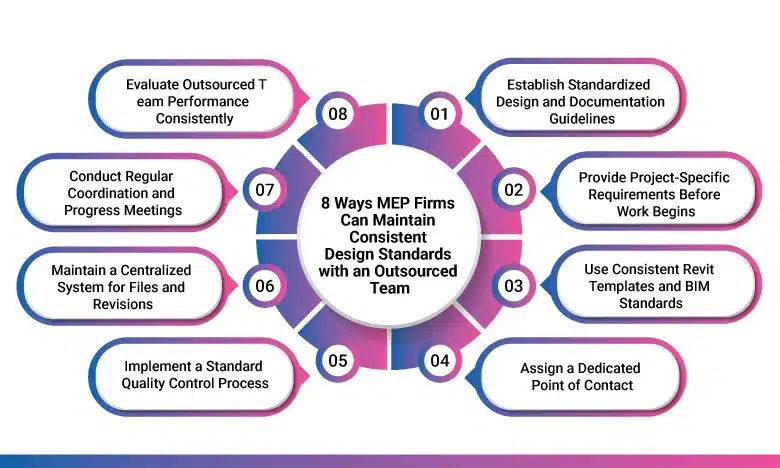
1. Establish Standardized Design and Documentation Guidelines
Before assigning work to an outsourced MEP team, establish clear documentation standards that apply across projects.
These guidelines should explain how your firm expects engineering drawings and project deliverables to be prepared.
Consider documenting:
- Drawing templates and sheet layouts.
- Layer and line-type conventions.
- Text styles, dimensions, and annotation standards.
- File naming and folder structures.
- Revit templates and modeling requirements.
- Drawing issue and revision procedures.
A shared standards document gives internal and outsourced teams a common reference. It also reduces the chances of different team members interpreting project requirements differently.
2. Provide Project-Specific Requirements Before Work Begins
Standardization does not mean every project follows exactly the same design approach. Each project may have different client expectations, building requirements, drawing standards, and deliverables.
MEP firms should provide a clear project brief before assigning work to an external team.
The brief should include:
- Project scope and deliverables.
- Architectural and structural backgrounds.
- Applicable design criteria and project specifications.
- Client-specific documentation requirements.
- Required software and file formats.
- Project milestones and submission deadlines.
- Internal review and approval procedures.
Providing this information at the beginning helps the outsourced team understand the firm’s expectations and reduces avoidable revisions later.
3. Use Consistent Revit Templates and BIM Standards
When MEP firms use Revit for design and documentation, maintaining consistent BIM standards becomes especially important.
Different modeling practices across teams can create coordination problems and increase the time required for model reviews.
To avoid this, provide outsourced teams with approved Revit templates, families, view templates, and project standards wherever applicable.
Establish guidelines for:
- Revit project setup and model organization.
- Family naming and parameter conventions.
- Worksets and linked models.
- View templates and sheet organization.
- Model development and documentation requirements.
- BIM coordination and clash detection procedures.
Using shared BIM standards helps external teams produce models that align with the firm’s internal workflow and are easier to review, coordinate, and update.
4. Assign a Dedicated Point of Contact
Communication becomes more complicated when multiple projects and teams operate simultaneously.
If internal engineers, project managers, and outsourced team members communicate independently without clear responsibilities, instructions can become inconsistent.
Assign a dedicated project coordinator or engineering lead to manage communication between both teams.
This person should be responsible for:
- Sharing project instructions and updates.
- Clarifying design-related questions.
- Communicating client requirements.
- Tracking deliverables and deadlines.
- Coordinating drawing reviews.
- Managing revisions and feedback.
A clear communication structure ensures that outsourced teams receive consistent instructions and that project decisions are communicated to the right people.
5. Implement a Standard Quality Control Process
Quality control should be part of every project workflow, not something performed only before final submission.
MEP firms should establish a consistent review process for all outsourced deliverables.
A practical quality control process can include:
Stage 1: Initial review
Check whether the outsourced team has followed the project brief, drawing standards, and documentation requirements.
Stage 2: Technical review
Have qualified internal engineers review the engineering work for compliance with project requirements, design criteria, and applicable codes.
Stage 3: Coordination review
Check coordination with architectural and structural backgrounds, as well as other MEP disciplines.
Stage 4: Final documentation review
Verify drawing organization, annotations, revision details, sheet references, and submission requirements.
Using the same review criteria across projects helps MEP firms maintain predictable quality, regardless of which team prepares the deliverables.
6. Maintain a Centralized System for Files and Revisions
Managing multiple projects often means handling several versions of drawings, models, markups, and client comments.
Without proper document control, teams may work from outdated files or miss important design changes.
MEP firms should establish a centralized system for managing project information.
This system should define:
- Where project files are stored.
- How drawing and model revisions are identified.
- Who can access and modify project files.
- How markups and review comments are shared.
- How approved and superseded documents are maintained.
- How final deliverables are issued.
A structured document management process helps internal and outsourced teams work from the correct information and reduces errors caused by outdated files.
7. Conduct Regular Coordination and Progress Meetings
Even with standardized guidelines, regular communication is necessary to keep multiple projects aligned.
MEP firms should schedule coordination meetings based on project complexity and delivery schedules.
These meetings can cover:
- Current project progress.
- Upcoming submission deadlines.
- Design changes and pending decisions.
- Technical questions and coordination issues.
- Quality review comments.
- Resource availability and workload.
Short, focused meetings help identify issues early and prevent small communication gaps from becoming larger project delays.
8. Evaluate Outsourced Team Performance Consistently
Maintaining design standards also requires evaluating whether the outsourced team is following the agreed workflow.
MEP firms should track performance across multiple projects instead of judging a partner based on one successful delivery.
Useful performance indicators include:
- First-pass approval rate.
- Number of revisions required.
- On-time delivery rate.
- Compliance with documentation standards.
- Response time to technical queries.
- Coordination and quality review findings.
Regular performance reviews help firms identify areas for improvement and determine whether their outsourced engineering partner can support long-term project requirements.
Common Mistakes MEP Firms Should Avoid
Even experienced MEP firms can face consistency issues when working with outsourced teams. Some common mistakes include:
1. Providing incomplete project information: Missing specifications, backgrounds, or design criteria can lead to assumptions and unnecessary revisions.
2. Using different standards for different teams: When internal and external teams follow separate documentation practices, deliverables may become inconsistent.
3. Skipping quality reviews: Assuming that an experienced outsourced team will always deliver work without errors can create avoidable project risks.
4. Poor revision management: Unclear revision procedures can result in outdated drawings and repeated work.
5. Choosing partners based only on cost: A low-cost provider may not offer the communication, technical capabilities, or quality control needed for consistent project delivery.
The solution is to treat outsourced engineering teams as an extension of the firm’s project delivery workflow, with clearly defined responsibilities and expectations.
How the Right Outsourced MEP Engineering Partner Helps
Maintaining consistent standards becomes easier when an outsourced engineering partner understands your firm’s processes and can follow established project requirements.
A reliable partner should be able to:
- Follow your firm’s drawing and documentation standards.
- Work with your approved Revit templates and BIM requirements.
- Adapt to project-specific instructions.
- Maintain clear communication with internal teams.
- Follow structured quality control procedures.
- Support multiple projects without disrupting existing workflows.
The objective is not simply to outsource individual engineering tasks. It is to establish a working relationship that supports your firm’s existing processes and maintains consistent deliverable quality as project requirements change.
How MVN Engineering Supports MEP Firms
MVN Engineering Services provides MEP design and BIM support to engineering firms working on projects in the United States and Canada.
We understand that every MEP firm has its own project standards, documentation requirements, and internal workflows. Our approach focuses on understanding these requirements and aligning our engineering and production support with each client’s project expectations.
Our services include:
- MEP Design Services
- HVAC Design Services
- Electrical Design Services
- Plumbing Design Services
- Fire Protection Design Services
- MEP BIM Services
- BIM Coordination and Clash Detection
- Shop Drawings and Engineering Documentation
By working with established project guidelines, coordinated workflows, and clear communication, MVN Engineering aims to help MEP firms manage project workloads while maintaining consistency across deliverables.
Whether your firm needs additional engineering capacity for ongoing projects or support during periods of increased workload, an experienced external team can help extend your production capabilities.
Conclusion
Maintaining consistent design standards across multiple projects requires more than having skilled engineers. MEP firms need standardized documentation, clear project requirements, structured communication, reliable quality control, and effective revision management.
When these processes are established, outsourced MEP engineering teams can work alongside internal staff without creating unnecessary differences in project deliverables.
For growing MEP firms, the right outsourcing partnership can provide additional engineering capacity while supporting established design standards, project workflows, and quality expectations.
Looking for reliable MEP design and BIM support for your upcoming projects? Connect with MVN Engineering to discuss your project requirements.