
 9 min read

Outsourcing MEP design can help engineering firms manage increasing workloads, meet demanding project schedules, and access additional technical resources without continuously expanding their in-house team.
However, choosing the right outsourcing partner is not simply about comparing hourly rates. The quality of the engineering partner directly affects design accuracy, project schedules, coordination, documentation, and ultimately your relationship with your clients.
For U.S. MEP design firms, the right partner should function as an extension of the internal team not simply as a vendor completing assigned drawings.
So, how do you identify the right MEP design outsourcing partner?
This guide outlines the key factors MEP firms should evaluate before making a decision.
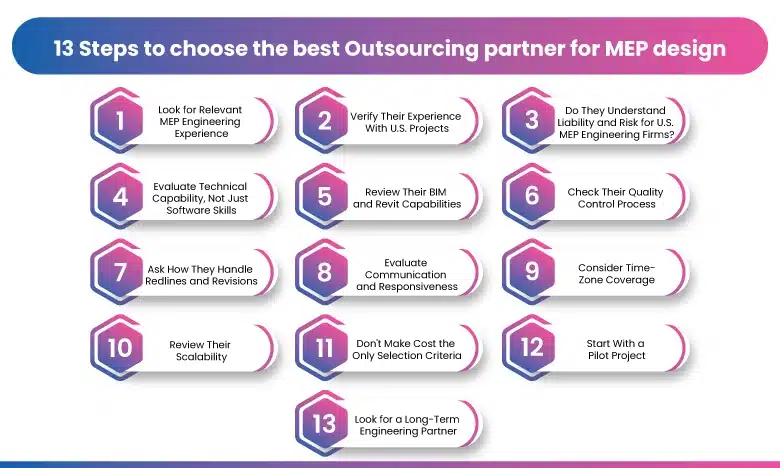
13 Steps to choose the best Outsourcing partner for MEP design
1. Look for Relevant MEP Engineering Experience
The first consideration should be the partner’s actual experience with MEP engineering projects.
An outsourcing company may have strong CAD or BIM capabilities, but that does not automatically mean it understands the requirements of MEP design.
Evaluate whether the company has experience in the disciplines you require, such as:
- HVAC and mechanical design
- Electrical design
- Plumbing design
- Fire protection design
- MEP coordination
- Revit MEP modeling
- Construction documentation
- Engineering calculations
- Design development
- As-built documentation
It is also useful to review the types of buildings the team has worked on, such as multifamily, commercial, healthcare, hospitality, industrial, retail, and warehouse projects.
The closer the partner’s experience is to your project requirements, the less time your team will need to spend explaining processes and correcting avoidable mistakes.
2. Verify Their Experience With U.S. Projects
If your firm serves the U.S. market, international engineering experience alone is not enough.
Outsourcing partners should understand how MEP projects are developed and documented for U.S. clients and should be comfortable working within your firm’s established standards and workflows.
Before selecting a partner, ask:
- Have you worked with U.S.-based MEP firms?
- What types of U.S. projects have you supported?
- Are your engineers familiar with U.S. project documentation requirements?
- Can you work according to our templates and standards?
- How do you handle project-specific requirements?
- How do you coordinate with architects and other consultants?
A partner familiar with U.S. project workflows can reduce the amount of supervision required from your internal team.
3. Do They Understand Liability and Risk for U.S. MEP Engineering Firms?
MEP design directly impacts building safety, construction costs, schedules, and code compliance. Therefore, your outsourcing partner should understand engineering responsibility, liability, and project risk, not just drafting or modeling.
Before selecting a partner, consider:
Clearly defined responsibilities: Establish which tasks the partner will handle, such as Revit modeling, drafting, design documentation, coordination, and revisions, and which responsibilities remain with your U.S. MEP firm.
Final engineering review: Confirm that outsourced work can be reviewed and approved by the appropriate professionals within your U.S. engineering firm before final documents are issued.
U.S. codes and standards: Ensure the partner understands applicable codes, standards, and project requirements and knows when to escalate technical questions.
QA/QC process: Ask how the partner reviews deliverables, manages errors, handles comments, controls revisions, and identifies coordination issues.
Clear contractual terms: Define the scope, deliverables, review responsibilities, confidentiality, data handling, intellectual property, and escalation procedures.
The right partner should understand the difference between engineering production support and professional engineering responsibility and work within your firm’s established review and approval process.
Ultimately, both teams should be clear about who produces, reviews, coordinates, approves, and issues the final engineering documents. Clear responsibilities help reduce misunderstandings and project risk.
4. Evaluate Technical Capability, Not Just Software Skills
Having access to Revit, AutoCAD, or other design software does not necessarily make an outsourcing team technically strong.
There is a major difference between producing a model and understanding the engineering behind the model.
When evaluating a potential partner, determine whether the team understands the engineering principles behind the work they produce.
For example, a capable HVAC design team should understand factors such as:
- Heating and cooling loads
- Equipment selection
- Air distribution
- Ventilation
- Duct sizing
- Piping systems
- Energy considerations
- Equipment coordination
- Constructability
Likewise, electrical, plumbing, and fire protection teams should demonstrate discipline-specific technical knowledge.
Your outsourcing partner should be capable of producing technically sound deliverables not merely following instructions mechanically.
5. Review Their BIM and Revit Capabilities
For many modern building projects, BIM and Revit are central to the design and coordination process.
When assessing an outsourcing partner, look beyond the question, “Do you use Revit?”
Instead, evaluate how well the team works within a BIM environment.
Consider their ability to handle:
- Revit MEP modeling
- BIM coordination
- Clash identification
- Model cleanup
- Families and content
- Templates
- Model standards
- Construction documentation
- Design revisions
- Architectural and structural coordination
- Model QA/QC
A good outsourcing partner should be able to work within your existing Revit standards rather than forcing your team to adopt an entirely different workflow.
6. Check Their Quality Control Process
Quality control is one of the most important factors when outsourcing MEP design.
A low-cost partner can quickly become expensive if your engineers have to spend significant time reviewing and correcting every deliverable.
Ask potential partners to explain their QA/QC process.
A mature process may include:
- Engineer or designer completes the assigned work.
- Internal review is performed.
- Drawings or models are checked against project requirements.
- Coordination issues are identified.
- Corrections are completed.
- Final deliverables are reviewed before submission.
You should also determine who is responsible for checking the work and what documentation is maintained during the review process.
7. Ask How They Handle Redlines and Revisions
MEP projects rarely remain unchanged from beginning to end.
Architectural revisions, client requests, coordination changes, equipment changes, and site conditions can all require modifications to the MEP design.
Your outsourcing partner therefore needs a reliable revision-management process.
Ask:
- How are redlines received and tracked?
- How are design changes documented?
- How are revisions communicated to the team?
- How quickly can changes be incorporated?
- How do you prevent outdated information from entering the final drawings?
A structured revision process can significantly reduce coordination errors.
8. Evaluate Communication and Responsiveness
Technical capability is only one part of a successful outsourcing relationship.
Communication can become a major challenge when working with an external team, particularly when projects have tight deadlines.
Before entering a long-term engagement, determine:
- Who will be your primary point of contact?
- How frequently will progress updates be provided?
- How are technical questions escalated?
- How quickly does the team respond to requests?
- What communication platforms do they use?
- How will urgent project changes be handled?
The ideal partner should make communication easier, not create another layer of project management for your team.
9. Consider Time-Zone Coverage
Working with an offshore team can provide a significant advantage when managed correctly.
A time-zone difference can allow work to continue beyond your local business hours, potentially creating a continuous production cycle.
However, this only works when communication and handoffs are structured properly.
Ask the outsourcing partner how they manage:
- Daily communication
- Project handoffs
- Urgent revisions
- Design questions
- Review cycles
- Meeting schedules
- Turnaround expectations
The objective should be to create a workflow where your internal team can review completed work and provide feedback without unnecessary delays.
10. Review Their Scalability
Your outsourcing requirements may change significantly from one month to another.
You may need only one designer for a small project today and additional resources when several projects enter the documentation stage simultaneously.
A good outsourcing partner should be able to scale with your workload.
Ask whether they can provide:
- Dedicated engineers
- Additional designers during peak workloads
- Multi-discipline support
- Short-term project support
- Long-term dedicated teams
Scalability can be particularly valuable for growing MEP firms that want additional capacity without committing to permanent hiring for every workload increase.
11. Don’t Make Cost the Only Selection Criteria
Cost is naturally an important consideration when outsourcing.
However, selecting the cheapest provider can create hidden costs through:
- Rework
- Poor-quality documentation
- Missed deadlines
- Coordination problems
- Excessive supervision
- Communication delays
- Client dissatisfaction
Instead of comparing only hourly rates, evaluate the total value delivered.
A partner that costs slightly more but produces accurate work with fewer revisions may ultimately be more economical than a low-cost provider requiring extensive supervision.
The better question is:
How much reliable engineering capacity am I getting for my investment?
12. Start With a Pilot Project
Before committing to a large outsourcing relationship, consider starting with a small project or defined scope.
A pilot project allows your team to evaluate:
- Technical quality
- Communication
- Turnaround time
- QA/QC
- Ability to follow standards
- Responsiveness to feedback
- Revit/BIM workflow
- Overall reliability
This provides a much clearer picture of the partnership than a sales presentation or capability brochure.
If the pilot performs well, you can gradually expand the relationship.
13. Look for a Long-Term Engineering Partner
The best outsourcing relationships are not based on repeatedly assigning isolated tasks.
Over time, an effective partner should become familiar with your:
- Design standards
- Templates
- Documentation preferences
- Review process
- BIM standards
- Communication procedures
- Project types
- Client expectations
This familiarity can make each subsequent project more efficient.
For this reason, MEP firms should evaluate outsourcing companies based not only on their ability to complete today’s project but also on their potential to become a dependable extension of the internal engineering team.
A Practical Checklist for Selecting an MEP Outsourcing Partner
Before selecting a partner, consider the following checklist:
| Evaluation Area | What to Look For |
| MEP expertise | Relevant mechanical, electrical, plumbing, and fire protection experience |
| U.S. experience | Familiarity with U.S. projects and workflows |
| Technical capability | Engineering knowledge beyond software operation |
| Revit/BIM | Strong modeling, coordination, and documentation capabilities |
| QA/QC | Defined review and quality-control procedures |
| Communication | Clear points of contact and responsive communication |
| Scalability | Ability to increase or decrease resources |
| Turnaround | Ability to meet project schedules |
| Security | Appropriate protection of project and client information |
| Cost | Competitive pricing without sacrificing quality |
| Flexibility | Ability to work according to your standards and processes |
| Track record | Relevant project experience and client references |
Conclusion
Choosing the right MEP design outsourcing partner is ultimately about finding the right balance between technical expertise, quality, communication, reliability, scalability, and cost.
For U.S. MEP design firms, an effective outsourcing partner should be capable of integrating into the existing project workflow and operating as an extension of the internal team.
Rather than choosing a provider solely because it offers the lowest price, evaluate how effectively the team can help you increase capacity, maintain quality, meet deadlines, and manage project workloads.
A carefully selected engineering partner can allow an MEP firm to take on more work without proportionally increasing its internal resources.