
 6 min read
U.S. MEP firms are under pressure to deliver faster, reduce costs, and handle more projects with limited internal teams. Traditional hiring is slow and expensive, making it difficult to scale efficiently.
Firms working in Mechanical, Electrical, and Plumbing engineering are increasingly struggling to keep up with growing project demand while maintaining healthy profit margins.
The reality is simple: demand is rising faster than internal capacity.
To make things more challenging, hiring mid-level engineers in the U.S. now costs between $80,000 and $120,000 per year, not including benefits, software, and infrastructure costs. At the same time, project delays can reduce profit margins by 10–15%, especially in time-sensitive commercial developments.
This creates a serious scalability problem for many firms.
This is where offshore MEP design support is changing how firms grow
What Is Offshore MEP Design Support?
Offshore MEP design support is not about replacing your in-house team, it’s about extending it.
In this model, U.S.-based firms collaborate with skilled engineering teams located in countries like India or Eastern Europe. These offshore teams handle time-intensive tasks such as:
- CAD drafting
- BIM modeling
- Shop drawings
- Design documentation
- Clash detection
This allows your core team to focus on higher-value responsibilities like design decisions, client communication, and project management.
Think of it as adding capacity without adding long-term overhead.
The Core Problem: Capacity Bottlenecks Are Slowing Growth
Across the industry, similar challenges are being reported by engineering managers and firm owners:
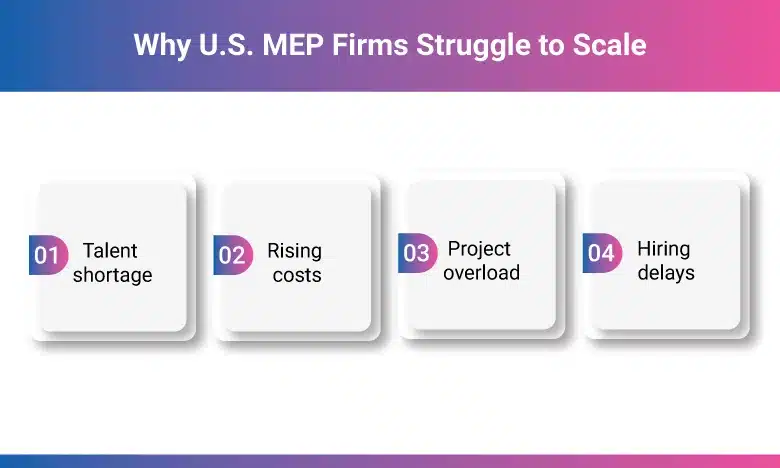
- We’re turning down projects due to lack of staff
- Our team is overloaded with BIM and drafting work
- Deadlines are slipping because of resource constraints
- Hiring takes 2–4 months, sometimes longer
These issues directly affect project delivery and client satisfaction.
A major contributor is the increasing complexity of digital workflows in Building Information Modeling (BIM). While BIM improves coordination and accuracy, it also demands skilled resources for modeling, documentation, and clash resolution.
As a result:
- BIM coordination delays are becoming more common
- Rework is increasing due to rushed designs
- Internal teams are stretched beyond optimal capacity
Without additional scalable support, firms risk losing both efficiency and revenue opportunities.
Key Benefits of Offshore MEP Design Support
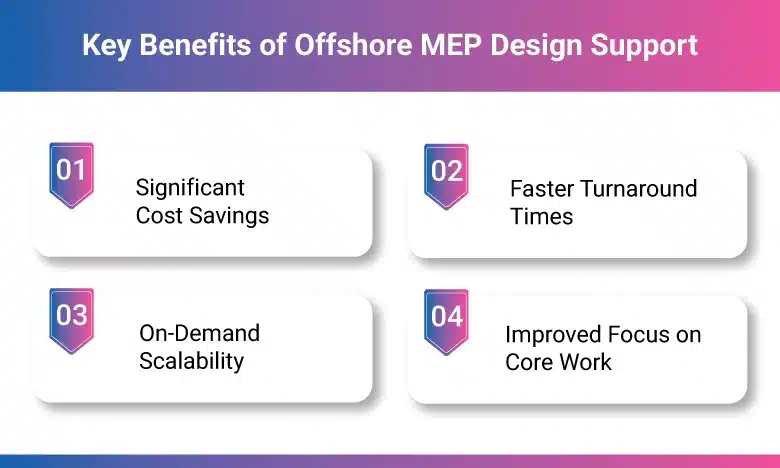
1. Significant Cost Savings
One of the most immediate advantages is cost efficiency. Offshore resources typically cost 40–60% less than their U.S. counterparts.
Additionally, you avoid expenses related to:
- Employee benefits
- Office infrastructure
- Software licenses (in many cases)
- Recruitment and training
These savings can be reinvested into business development or technology upgrades.
2. Faster Turnaround Times
With teams operating in different time zones, work can continue even after your U.S. office closes.
This creates a near 24-hour production cycle, leading to:
- 30–50% faster project delivery
- Quicker turnaround on revisions
- Reduced idle time between tasks
For firms dealing with tight deadlines, this is a major competitive advantage.
3. On-Demand Scalability
Unlike traditional hiring, offshore teams can be scaled up or down quickly often within 1 to 2 weeks.
This flexibility allows you to:
- Handle peak workloads without stress
- Take on larger or multiple projects
- Avoid long-term commitments during slow periods
4. Improved Focus on Core Work
By offloading drafting and modeling tasks, your in-house engineers can focus on:
- System design and optimization
- Client coordination
- Code compliance
- Quality assurance
This not only improves productivity but also enhances overall project quality.
Real Workflow: How Offshore Teams Integrate with U.S. Firms
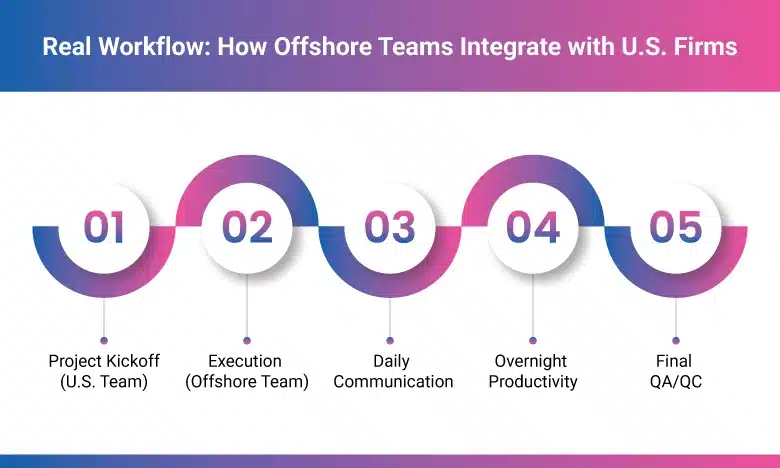
One of the biggest misconceptions about offshore support is that it’s complicated. In reality, with the right structure, integration is smooth and highly efficient.
Here’s what a typical workflow looks like:
Step 1: Project Kickoff (U.S. Team)
Your internal team defines:
- Project scope
- Design standards
- Local codes and requirements
- Initial markups or reference files
Step 2: Execution (Offshore Team)
The offshore team begins work using industry-standard tools such as:
- AutoCAD for drafting
- Autodesk Revit for modeling
- Navisworks for clash detection and coordination
Step 3: Daily Communication
Teams stay aligned through:
- 1–2 hours of overlapping work time
- Daily or weekly progress updates
- Collaboration platforms like BIM 360, Slack, or Microsoft Teams
Step 4: Overnight Productivity
While your U.S. team logs off, the offshore team continues working. By the next morning, progress is ready for review.
Step 5: Final Review and Delivery
Your in-house engineers perform:
- QA/QC checks
- Design validation
- Final approvals before client submission
This ensures full control over quality and compliance.
Will offshore teams understand U.S. codes?
Yes, Experienced offshore teams are trained in:
- NEC (National Electrical Code)
- ASHRAE standards
- Local U.S. building regulations
They work under strict project-specific compliance guidelines.
In many cases, specialized offshore partners such as MVN Engineering, a dedicated MEP/BIM design support team, are structured specifically around U.S. project requirements. Teams like these operate with standardized checklists, code references, and review workflows aligned with American construction practices to ensure accuracy and compliance from the start.
This type of setup helps eliminate one of the biggest concerns firms have whether offshore teams can truly understand and execute according to U.S. engineering standards.
When Should MEP Firms Consider Offshore Support?
Offshore design support is especially valuable when:
- You are turning down projects due to capacity constraints
- Your internal team is consistently overloaded
- Hiring timelines are too slow to support growth
- Project deadlines are becoming difficult to meet
- You want to scale without increasing fixed overhead
Conclusion
Offshore MEP design support is no longer just a cost-cutting tactic. It is a strategic growth enabler for modern engineering firms.
By combining local expertise with global delivery capacity, firms can:
- Reduce costs by up to 60%
- Improve turnaround time by up to 50%
- Scale operations in weeks instead of months
- Increase project capacity without increasing internal stress
In a competitive U.S. construction market, firms that adopt global delivery models gain a clear advantage.
Offshore support isn’t just about doing more with less it’s about unlocking the ability to grow without limits.