
 5 min read

Introduction
For MEP consulting firms, choosing an engineering partner is not simply a decision about completing design tasks or reducing workload. It is a decision that can directly impact project success, client relationships, reputation, and long-term business growth.
While cost is always an important consideration, the lowest-priced engineering partner is not necessarily the best choice. In MEP design, small mistakes can lead to major consequences, including coordination conflicts, permit delays, construction issues, rework, and loss of client confidence.
For growing MEP firms, the right engineering partner should provide more than additional resources. They should provide reliability, technical expertise, strong quality control processes, and the confidence that every deliverable represents the same level of professionalism expected from your internal team.
Why the Lowest-Cost Engineering Partner Is Not Always the Best Choice
When evaluating external engineering support, some firms may initially focus on hourly rates or project costs. However, the true cost of an engineering partnership extends beyond the initial price.
A low-cost provider may create additional challenges, such as:
- Inaccurate drawings or models
- Poor understanding of project requirements
- Increased review time for internal engineers
- Coordination problems with other disciplines
- Delays during design or permit submission
- Additional corrections and rework
These issues can quickly eliminate any initial cost savings.
For MEP firms, the priority should not be finding the cheapest option. It should be finding a partner who helps deliver projects accurately, efficiently, and consistently.
MEP Design Errors Can Impact the Entire Project
MEP systems are critical components of any building project. Mechanical, electrical, plumbing, and fire protection designs must work together with architectural and structural elements while meeting applicable codes and project requirements.
A design error can affect:
- Construction schedules
- Material procurement
- Installation costs
- Contractor coordination
- Client satisfaction
- Project profitability
For an MEP consulting firm, these impacts can extend beyond one project. A single mistake can affect the firm’s reputation and future opportunities with clients.
This is why engineering quality should be the foundation of any partnership decision.
A Reliable Engineering Partner Protects Your Reputation
When an MEP firm works with an external engineering team, that partner becomes an extension of the firm’s own capabilities.
Clients may not see the difference between internal and external resources. They only see the final outcome:
- Was the design accurate?
- Were deliverables completed on time?
- Were coordination issues minimized?
- Did the project move forward smoothly?
- They have knowledge about code-compliance US standard?
A trusted engineering partner understands that their work directly represents the MEP firm’s reputation.
The right partner follows established processes, communicates clearly, and takes ownership of delivering high-quality engineering support.
What Defines a Quality MEP Engineering Partner?
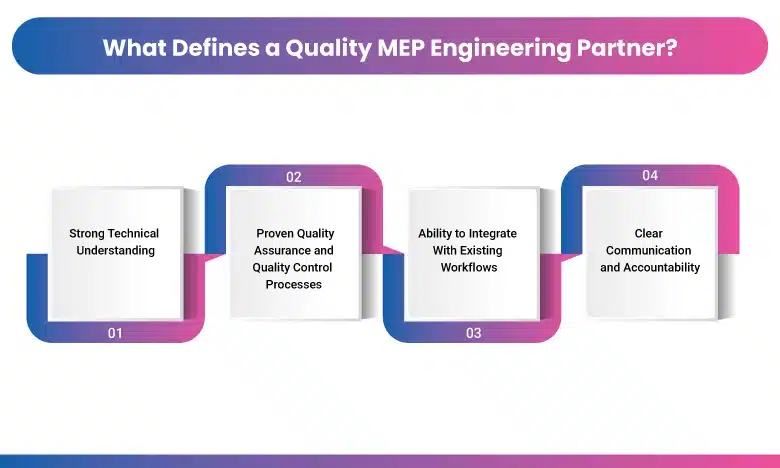
A strong engineering partner is not defined only by technical skills. Quality comes from a combination of experience, processes, communication, and commitment.
1. Strong Technical Understanding
A reliable partner should understand MEP engineering principles, design workflows, documentation requirements, and industry expectations.
They should be capable of supporting projects while following the standards and procedures established by the MEP firm.
2. Proven Quality Assurance and Quality Control Processes
Quality should not depend on individual effort alone. A professional engineering partner should have structured QA/QC processes to identify and resolve issues before deliverables reach the client.
Effective quality control includes:
- Design reviews
- Coordination checks
- Drawing verification
- Model reviews
- Documentation standards
- Internal approval processes
3. Ability to Integrate With Existing Workflows
The best engineering partnerships feel like an extension of the internal team.
A capable partner should be able to adapt to:
- Existing project workflows
- BIM standards
- Communication methods
- Documentation procedures
- Project management expectations
This allows the MEP firm to maintain control while increasing engineering capacity.
4. Clear Communication and Accountability
Successful engineering collaboration requires more than technical capability. Communication is essential.
A reliable partner should provide:
- Regular project updates
- Quick responses to questions
- Clear understanding of requirements
- Transparency about project progress
- Ownership of assigned responsibilities
Good communication reduces uncertainty and helps projects move forward smoothly.
Why Long-Term Engineering Partnerships Deliver More Value
The best results come from partnerships built over time.
When an MEP firm works repeatedly with the same engineering partner, both teams develop a better understanding of:
- Design preferences
- Internal standards
- Project expectations
- Quality requirements
- Communication processes
This creates efficiency and consistency that cannot be achieved through constantly changing vendors.
A long-term engineering partner becomes familiar with the firm’s approach and can contribute more effectively to future projects.
How MEP Firms Should Evaluate Potential Engineering Partners
Before selecting an engineering partner, firms should consider questions such as:
- Does this partner understand our quality expectations?
- Do they have a proven QA/QC process?
- Can they integrate with our existing workflow?
- Do they prioritize accuracy over speed alone?
- Can they support us consistently as project demands increase?
- Will they protect our reputation with our clients?
The right partner should provide confidence, not additional management challenges.
Building Growth Through the Right Engineering Partnership
Many MEP firms face increasing project demand while dealing with challenges such as limited engineering resources, hiring difficulties, and tight deadlines.
A trusted engineering partner can help firms expand capacity while maintaining the quality standards that built their reputation.
The goal is not simply to complete more work. The goal is to deliver more successful projects while protecting client relationships and engineering standards.
Conclusion
When selecting an MEP engineering partner, cost should be considered but it should never be the only deciding factor.
The true value of a partnership comes from quality, reliability, technical expertise, and the ability to consistently deliver accurate engineering solutions.
For U.S. MEP firms, the right engineering partner is not just a service provider. They are an extension of the team, helping the firm take on new opportunities while maintaining the trust and quality their clients expect.
At MVN Engineering, we believe successful partnerships are built on engineering excellence, strong communication, and a shared commitment to delivering high-quality project outcomes.