
 9 min read

MEP design outsourcing has become an increasingly common strategy for U.S.-based AEC and MEP firms looking to manage workload, reduce overhead, and meet aggressive project deadlines.
From schematic design to detailed MEP engineering and construction documentation, offshore support teams are now widely used across HVAC, plumbing, and electrical design workflows.
However, despite the growing adoption, many firms report a similar outcome:
Projects still face coordination issues, design inconsistencies, and unexpected rework during construction.
This leads to an important question:
If MEP design outsourcing is so widely used, why does it often fail to deliver expected results?
The answer is not about outsourcing itself, it is about execution quality, engineering depth, and accountability.
Let’s break it down.
Why Most Offshore MEP Design Projects Fail
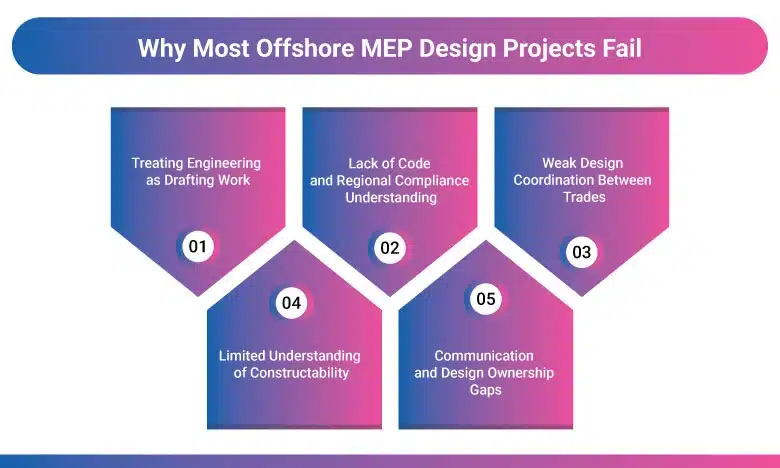
1. Treating Engineering as Drafting Work
One of the most common failures in offshore MEP design outsourcing is the reduction of engineering to drafting execution.
Instead of true design development, many teams operate with a mindset of:
“Convert inputs into drawings.”
But MEP design is not drawing production, it is engineering problem-solving.
It requires:
- load calculations and system sizing
- code compliance understanding
- coordination with architectural and structural systems
- equipment selection logic
- system efficiency and constructability considerations
When engineering is treated as drafting, the output may appear complete on paper but fails during coordination or installation.
2. Lack of Code and Regional Compliance Understanding
MEP design is heavily dependent on regional codes, standards, and authority requirements.
Many offshore teams lack deep familiarity with:
- U.S. building codes
- ASHRAE guidelines
- NFPA requirements
- NEC electrical standards
- local permitting expectations
This results in designs that may be technically structured but non-compliant or misaligned with U.S. approval processes.
The consequence:
Revisions, redesign cycles, and delays during approval and construction stages.
3. Weak Design Coordination Between Trades
MEP systems do not exist in isolation; they are deeply interconnected.
A common failure point in offshore design delivery is poor inter-trade coordination:
- HVAC systems clashing with structure
- plumbing systems routed without spatial validation
- electrical layouts not coordinated with ceiling and lighting plans
Without integrated coordination thinking, design packages become fragmented rather than buildable.
4. Limited Understanding of Constructability
Design that works on paper does not always work in the field.
Many offshore teams lack exposure to:
- installation sequencing
- site constraints
- equipment access requirements
- maintenance clearance considerations
As a result, designs may need significant modification during construction, increasing cost and schedule risk.
5. Communication and Design Ownership Gaps
In many outsourcing models, offshore teams act as task executors rather than design owners.
This creates challenges such as:
- unclear accountability for design decisions
- delayed responses to design revisions
- misinterpretation of engineering intent
- dependency on intermediaries for communication
Without ownership, design becomes reactive instead of controlled.
The Hidden Cost of Poor MEP Design Outsourcing
While offshore outsourcing is often positioned as a cost-saving strategy, poor-quality execution can significantly increase total project cost.
Hidden costs include:
- repeated design revisions
- coordination delays across disciplines
- RFIs during construction
- rework due to non-compliant design
- inefficiencies in procurement and installation
- increased internal review workload
In many cases, the initial savings in hourly rates are outweighed by downstream project inefficiencies.
What High-Quality MEP Engineering Partners Do Differently
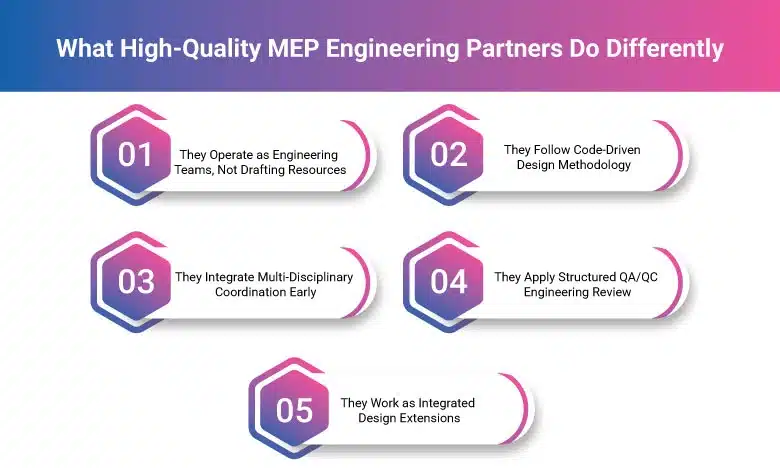
Not all offshore MEP design teams operate at the same level. High-performing partners differentiate themselves through engineering depth, process structure, and accountability.
1. They Operate as Engineering Teams, Not Drafting Resources
High-quality partners do not simply execute drawings; they actively participate in engineering development.
They understand:
- system design intent
- load calculations and sizing logic
- energy efficiency considerations
- coordination constraints
- compliance requirements
This shifts outsourcing from production support to engineering extension.
2. They Follow Code-Driven Design Methodology
Reliable MEP design partners build their workflows around compliance from the start.
This includes:
- alignment with U.S. building codes
- adherence to ASHRAE and NFPA standards
- early-stage compliance validation
- design documentation structured for approvals
This reduces redesign cycles and improves approval efficiency.
3. They Integrate Multi-Disciplinary Coordination Early
Instead of treating coordination as a final step, high-quality teams integrate it into the design process.
This includes:
- HVAC, plumbing, and electrical coordination during design development
- early clash avoidance strategies
- spatial planning aligned with architectural and structural systems
The result is a more constructible and efficient design package.
4. They Apply Structured QA/QC Engineering Review
Strong MEP design partners embed quality checks into every stage of design.
A typical structured process includes:
- internal engineering review of calculations and assumptions
- design validation against codes and standards
- coordination checks across disciplines
- pre-delivery quality assurance sign-off
This ensures design accuracy before client submission.
5. They Work as Integrated Design Extensions
Rather than functioning as external vendors, high-quality teams integrate into client workflows.
They:
- participate in design discussions
- align with U.S. project standards and expectations
- respond quickly to design iterations
- maintain clear communication loops with project teams
This creates continuity instead of fragmentation.
How Our MEP Design & BIM Coordination Process Prevents Rework
The difference between a standard outsourcing model and a reliable engineering partnership comes down to one thing:
process control.
Our approach is built around one principle:
Every design deliverable must be code-compliant, constructible, coordinated, and validated before submission.
This ensures that design is not just produced it is engineered for execution.
Step 1: Project Intake & Technical Alignment
Every project begins with structured technical alignment.
We first understand:
- project scope and design intent
- coordination expectations across disciplines
- LOD (Level of Development) requirements
- applicable codes and standards
- trade dependencies and interfaces
This step ensures that engineering decisions are aligned before production begins, reducing downstream ambiguity and redesign cycles.
Step 2: Structured Engineering & Design Development Approach
Design development is carried out using a coordination-first engineering mindset.
Our modeling and design process includes:
- system-level coordination planning
- constructability-aware routing and layout decisions
- real-world installation feasibility consideration
- early-stage inter-disciplinary alignment (HVAC, plumbing, electrical)
This ensures that design evolves as a coordinated system, not isolated components.
Step 3: Internal QA/QC Engineering Review
Before any client submission, every design package undergoes structured internal validation.
This includes:
- engineering accuracy and consistency checks
- compliance validation against relevant codes and standards
- inter-discipline coordination review
- design assumption verification
This step ensures that issues are identified internally — not during client review or construction.
Step 4: Coordination Readiness Check
Before delivery, we ensure the design is fully coordination-ready.
We validate that:
- all systems are aligned across trades
- spatial conflicts are resolved or mitigated
- installation feasibility is maintained
- critical design clashes are eliminated or documented
This step bridges the gap between design intent and construction reality.
Step 5: Client Collaboration & Structured Feedback Loop
We maintain a structured communication and review cycle with client teams.
This includes:
- clearly defined review milestones
- organized feedback tracking and implementation
- fast turnaround on revisions and clarifications
- transparent progress communication
This structured loop reduces miscommunication and ensures alignment at every stage.
Result of This Process
By following this workflow, we reduce:
- design rework cycles
- coordination conflicts
- approval delays
- construction-stage RFIs
And improve:
- design consistency
- constructability
- coordination efficiency
- delivery predictability
MEP Design Outsourcing Success Depends on Process, Not Location
One of the most common misconceptions in the industry is that offshore design quality is determined by geography.
In reality, success is determined by:
- engineering capability
- process maturity
- communication structure
- accountability systems
- compliance knowledge
Poor execution can exist anywhere locally or offshore. Similarly, high-performing engineering teams can be built globally when systems are strong.
How to Evaluate a Reliable MEP Design Outsourcing Partner
Before selecting an outsourcing partner, U.S. AEC and MEP firms should evaluate:
- Do they understand U.S. codes and compliance standards?
- Who is responsible for engineering decisions?
- How are calculations and assumptions validated?
- What QA/QC process is followed before submission?
- How is coordination handled across disciplines?
- Can they demonstrate real MEP design experience, not just drafting?
These questions reveal far more about capability than pricing alone.
Conclusion
MEP design outsourcing is not inherently risky but it must be executed with engineering discipline, not drafting execution.
When done correctly, it becomes a powerful extension of a firm’s design capability, helping teams:
- manage workload efficiently
- improve delivery timelines
- reduce internal engineering pressure
- scale without increasing overhead
But the difference between success and failure comes down to one factor:
Choosing a partner who thinks like an engineering team not a production vendor.
Because in MEP design, success is not defined by how fast drawings are produced.
It is defined by how well the design performs in the real world.