
 8 min read
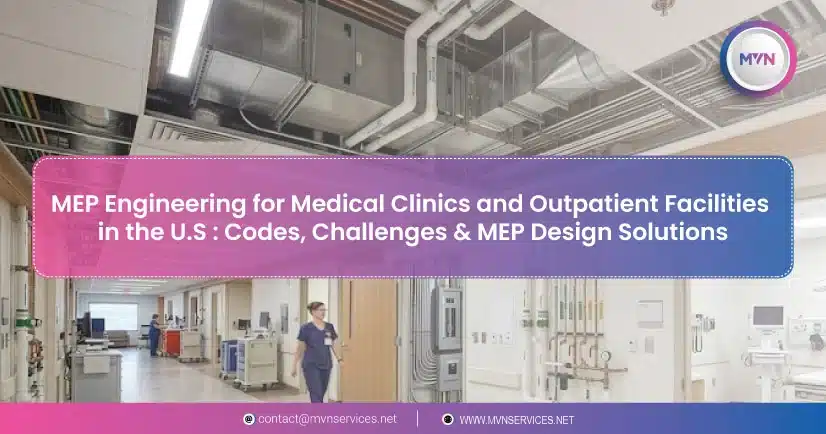
MEP engineering for medical clinics in the USA plays a critical role in the successful planning, design, and operation of healthcare facilities. As outpatient care continues to expand across the United States, the demand for efficient, code-compliant, and well-coordinated mechanical, electrical, and plumbing systems has increased significantly.
Unlike standard commercial buildings, outpatient facilities require stricter control of indoor air quality, reliable power systems, and specialized plumbing infrastructure to support patient care and medical equipment. Every decision in MEP design directly impacts patient safety, regulatory compliance, and operational efficiency.
This makes outpatient facility MEP design one of the most complex and responsibility-driven areas in building engineering.
Architects and engineering firms working on healthcare projects must balance performance, safety, and cost often within tight timelines. This makes MEP engineering a critical component of successful clinic design and delivery.
Why is MEP Engineering Critical for Medical Clinics?
MEP systems are the backbone of healthcare facilities. In medical clinics, they directly influence:
- Patient health and infection control
- Equipment reliability and performance
- Compliance with U.S. healthcare regulations
- Operational continuity during emergencies
Even minor design errors can lead to compliance failures, expensive redesigns, or operational disruptions. Therefore, early-stage coordination between architects and engineers is essential.
Key MEP Systems in Outpatient Facility Design
HVAC Design for Medical Clinics (ASHRAE Standards)
HVAC design for medical clinics is one of the most critical aspects of healthcare MEP systems, as it directly impacts infection control and patient safety.
Key requirements based on ASHRAE healthcare ventilation standards include:
- Air Changes per Hour (ACH): Different spaces such as examination rooms, waiting areas, and procedure rooms require specific ventilation rates.
- Filtration Levels: High-efficiency filters (such as HEPA) may be required in sensitive areas.
- Pressure Relationships: Maintaining positive or negative pressure in certain rooms helps control airborne contaminants.
- Temperature & Humidity Control: Essential for both patient comfort and equipment performance.
Improper HVAC design can lead to non-compliance, poor indoor air quality, and increased operational risks. For this reason, early coordination between architects and MEP engineers is essential.
Electrical Systems for Healthcare Facilities (NEC Compliance)
Electrical design in healthcare facilities must ensure uninterrupted operation of critical systems.
Key considerations based on NEC Compliance include:
- Backup Power Requirements for Clinics: Emergency power systems must support life-safety and critical equipment during outages.
- Load Segregation: Separation of essential and non-essential loads to prioritize critical operations.
- Equipment-Specific Power Needs: Diagnostic and treatment equipment often require dedicated circuits.
- Lighting Design: Proper illumination levels for clinical tasks and patient comfort.
Electrical systems must comply with the National Electrical Code (NEC) and relevant healthcare regulations, ensuring safety and reliability at all times.
Plumbing and Medical Gas Systems in Clinics
Plumbing systems in medical clinics extend beyond standard commercial applications.
They include:
- Domestic Water Supply: Designed for hygiene and consistent pressure
- Hot Water Systems: Critical for sanitation and infection control
- Drainage Systems: Designed to prevent contamination and ensure proper waste disposal
- Medical Gas Systems: Including oxygen, compressed air, and vacuum systems
Medical gas system design requirements are strictly regulated and must align with healthcare standards to ensure patient safety and system reliability.
Challenges in MEP Engineering for Medical Clinics and Outpatient Facilities
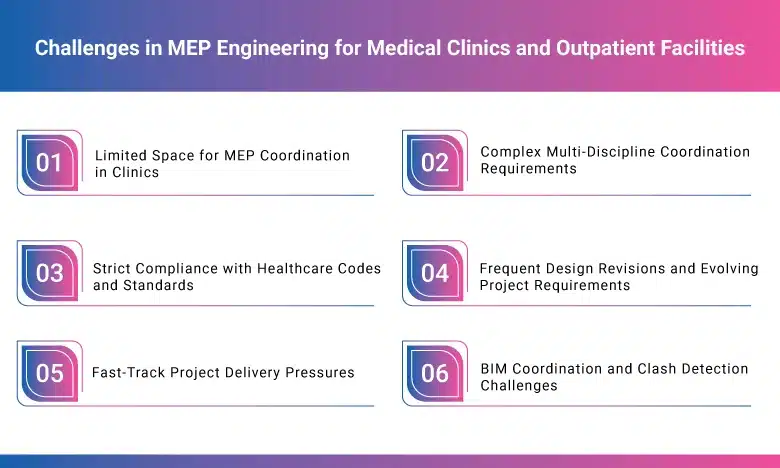
Limited Space for MEP Coordination in Clinics
One of the most common and critical challenges is the lack of available space for MEP systems.
Outpatient clinics are typically designed with:
- Compact ceiling plenums
- Dense medical equipment layouts
- Limited vertical shaft space
- High architectural finish expectations
This creates significant difficulty in routing ductwork, piping, conduits, and medical gas lines without clashes.
In many cases:
- HVAC ducts compete with structural beams
- Electrical conduits conflict with plumbing lines
- Medical gas routing requires strict segregation and accessibility
In many cases, changes happen during construction documentation or even on-site, causing delays and cost overruns.
Complex Multi-Discipline Coordination Requirements
Healthcare MEP design is inherently a multi-discipline coordination-heavy process. Mechanical, electrical, plumbing, structural, and architectural teams must work in close alignment from the beginning of the project.
However, challenges often arise due to:
- Late design changes from architectural updates
- Incomplete input from equipment planners or medical consultants
- Misalignment between structural and MEP layouts
- Lack of integrated BIM coordination early in the design phase
In outpatient facility projects, even small changes such as room reclassification or equipment relocation can trigger a cascade of MEP revisions across all systems.
This makes coordination not just a design task, but an ongoing management challenge throughout the project lifecycle.
Strict Compliance with Healthcare Codes and Standards
Healthcare facilities in the U.S. must comply with multiple overlapping standards, including:
- ASHRAE standards for ventilation and indoor air quality
- NFPA codes for fire protection and life safety
- NEC (National Electrical Code) for electrical safety
- FGI Guidelines for healthcare facility planning and design
The complexity lies not only in following these codes individually but in ensuring consistent compliance across all MEP systems simultaneously.
For example:
- HVAC air change requirements must align with infection control guidelines
- Electrical emergency systems must support life-safety loads defined by NFPA
- Plumbing and medical gas systems must meet strict separation and safety standards
Because these standards are frequently updated and vary by jurisdiction, maintaining compliance requires continuous attention and experience in healthcare-specific design.
Frequent Design Revisions and Evolving Project Requirements
Healthcare projects, especially outpatient facilities, often experience multiple design revisions during development stages.
Common reasons include:
- Changes in medical equipment specifications
- Updates in client requirements or room functions
- Regulatory review feedback
- Coordination issues discovered during BIM clash detection
Unlike standard commercial projects, healthcare design is highly dynamic because it depends on both architectural planning and medical operational requirements.
Each revision typically impacts multiple systems:
- A single room change can affect HVAC zoning, electrical load distribution, and plumbing layouts
- Equipment relocation may require redesign of power and data infrastructure
- Layout modifications can trigger full coordination updates in BIM models
This iterative nature increases workload and requires strong version control and disciplined design management.
Fast-Track Project Delivery Pressures
Many outpatient facility projects in the U.S. are executed on fast-track schedules, where design and construction phases overlap.
While this approach reduces overall project duration, it introduces significant challenges for MEP engineering teams:
- Limited time for coordination and validation
- Overlapping design stages increasing revision cycles
- Higher risk of incomplete or conflicting design inputs
- Pressure to deliver drawings for construction packages quickly
In such environments, even minor delays in MEP design can impact the entire project timeline.
Fast-track delivery also demands highly efficient workflows, strong communication, and the ability to quickly adapt to design changes without compromising quality.
BIM Coordination and Clash Detection Challenges
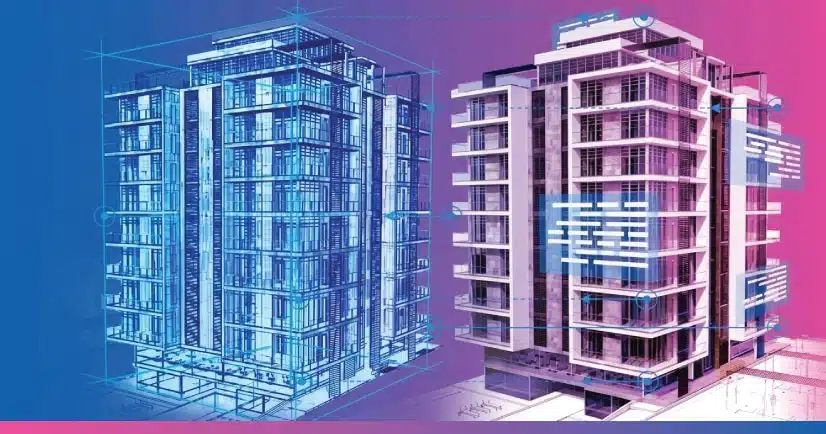
With widespread adoption of BIM (Building Information Modeling), coordination has improved but it has also introduced new challenges.
Common BIM-related issues include:
- Inconsistent modeling standards between teams
- Incomplete or outdated architectural references
- Clash detection overload due to dense healthcare systems
- Lack of clear responsibility for resolving conflicts
Healthcare facilities are particularly complex in BIM environments because they contain:
- High-density ceiling systems
- Multiple utility networks
- Equipment-heavy rooms requiring precise placement
Without structured BIM execution plans and clear coordination protocols, models can become difficult to manage and validate effectively.
Scaling MEP Engineering Capacity for Healthcare Projects Through Offshore Collaboration
As demand for MEP engineering for medical clinics and outpatient facilities in the U.S. continues to grow, many firms face challenges in managing complex healthcare designs within tight deadlines. These projects require high levels of coordination, strict compliance with ASHRAE, NFPA, NEC, and FGI standards, and continuous design revisions throughout development.
To handle increasing workloads, firms are adopting scalable engineering models that expand production capacity without increasing in-house staffing. This allows internal teams to focus on core design decisions while detailed MEP drafting, BIM modeling, and documentation are efficiently managed.
Work is typically coordinated through BIM tools like Revit and Navisworks, supported by cloud-based workflows, structured QA/QC, and regular communication cycles to ensure design accuracy and compliance.
This approach improves delivery speed, supports multiple healthcare projects simultaneously, and reduces internal workload pressure. MVN Engineering provides MEP drafting, BIM coordination, and documentation support as an integrated extension of U.S. engineering teams.
Conclusion
MEP engineering for medical clinics and outpatient facilities in the U.S. requires precision, compliance, and strong coordination between disciplines. As healthcare projects become more complex, firms are increasingly adopting scalable engineering solutions to meet deadlines and maintain quality.