
 9 min read
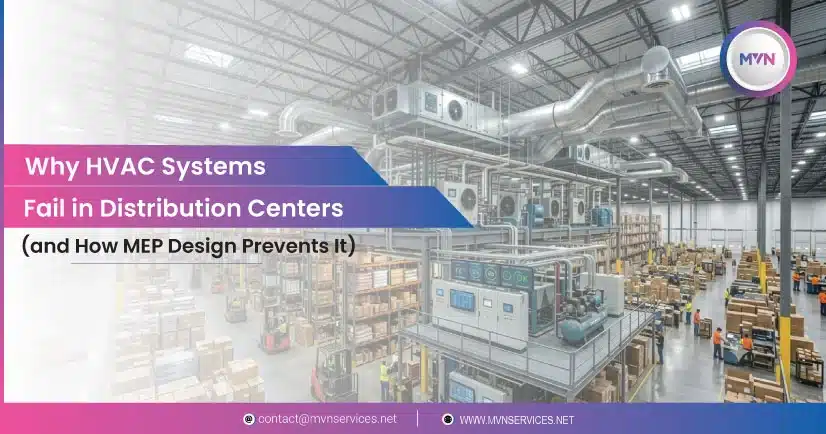
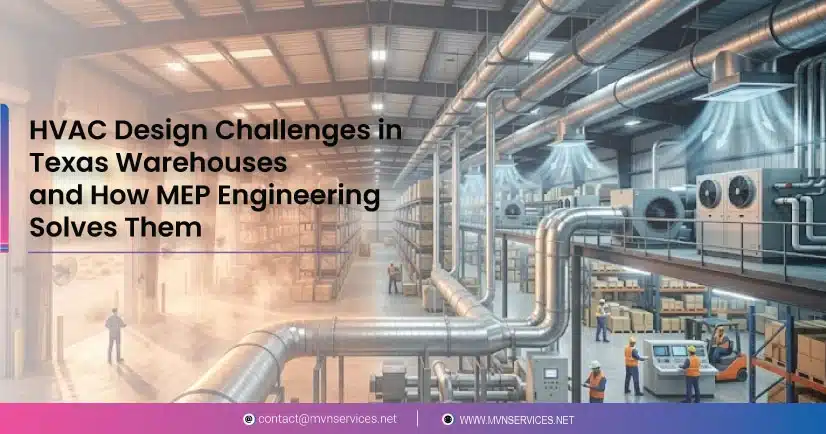
HVAC system fail in distribution centers are more common than most facility owners and AEC professionals expect. Despite advanced equipment and modern controls, many large-scale Distribution Centers still experience uneven temperatures, excessive energy consumption, and frequent operational inefficiencies.
In most cases, the issue is not the equipment itself, it is the engineering decisions made during design and coordination phases.
Distribution centers are high-volume, high-load environments where HVAC performance depends heavily on early-stage MEP design strategy, not just installation quality.
It is also important to note that HVAC systems typically account for 30% to 50% of total energy consumption in industrial and commercial buildings, meaning even small inefficiencies can create significant long-term operational costs.
This article explains why HVAC systems fail in distribution centers and how proper MEP design prevents these issues across both design and operational stages.
Why Distribution Centers Are Challenging for HVAC Systems
Unlike standard commercial buildings, distribution centers operate under extreme spatial and operational conditions that directly impact HVAC performance.
Key challenges include in that cause HVAC system fail in distribution centers:
- Large open floor areas with ceiling heights typically ranging from 25 to 40 feet
- Continuous movement of goods, forklifts, and personnel
- Frequent opening of loading dock doors
- High internal heat loads from lighting and equipment
- Variable occupancy and usage throughout the day
These conditions create complex airflow behavior, including thermal stratification, pressure imbalance, and uneven cooling distribution.
In such environments, temperature differences between floor level and ceiling level can reach 5°C to 12°C (9°F to 22°F) if airflow is not properly engineered and controlled.
Without a purpose-built HVAC strategy, maintaining consistent indoor conditions becomes extremely difficult.
Most HVAC issues in distribution centers can be traced back to a few recurring engineering and operational failures.
Common Reasons HVAC Systems Fail in Distribution Centers
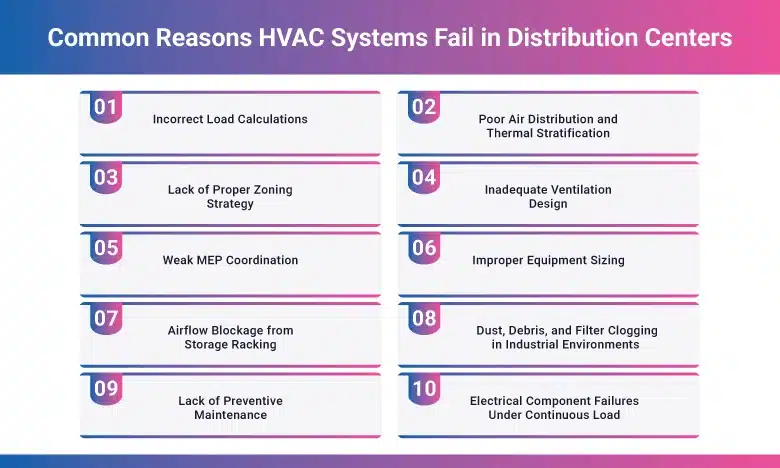
1. Incorrect Load Calculations
One of the most frequent root causes of HVAC failure is inaccurate load estimation during design.
Many systems fail because engineers do not fully account for:
- Actual operational heat gains from equipment and logistics activity
- Building envelope variations and insulation performance
- Future expansion or changes in facility usage
When load calculations are incorrect, HVAC systems are either undersized (leading to constant overload) or oversized (causing short cycling, increasing energy consumption by 10%–25%).
2. Poor Air Distribution and Thermal Stratification
Air distribution in large-volume spaces behaves very differently than in typical buildings.
Without proper engineering:
- Hot air rises and accumulates near the ceiling
- Cold air remains concentrated at floor level
- Large portions of the workspace experience uneven temperatures
This phenomenon, known as thermal stratification, leads to discomfort, reduced productivity, and inefficient system operation even when equipment is functioning correctly.
3. Lack of Proper Zoning Strategy
Many distribution centers are incorrectly treated as a single HVAC zone. In reality, these facilities include multiple functional areas such as:
- Loading and unloading docks
- Storage and racking zones
- Packaging and processing areas
- Administrative office spaces
Each zone has distinct thermal and ventilation requirements. Without proper zoning, HVAC systems waste energy conditioning areas that do not require the same level of control.
4. Inadequate Ventilation Design
Ventilation is often underestimated in large distribution centers environments.
Common issues include:
- Insufficient fresh air intake
- Poor exhaust air planning
- Failure to maintain code-required air changes
- Non-compliance with ventilation standards
Frequent loading dock activity can also introduce sudden air infiltration, increasing HVAC load by 10%–20% in high-traffic facilities.
This can result in poor indoor air quality, moisture accumulation, and regulatory compliance risks.
5. Weak MEP Coordination
HVAC systems do not operate in isolation; they are part of a fully integrated MEP system.
When coordination is weak, problems arise such as:
- Ductwork conflicts with structural elements
- Inefficient equipment placement
- On-site modifications that compromise design intent
These issues often result in rework, delays, and long-term performance inefficiencies.
6. Improper Equipment Sizing
Equipment selection plays a critical role in system performance.
- Oversized systems tend to short cycle, increasing wear and reducing efficiency
- Undersized systems operate continuously under stress, leading to premature failure
Both scenarios result in higher lifecycle costs and reduced system reliability.
7. Airflow Blockage from Storage Racking
High-density racking systems can significantly obstruct airflow paths.
This issue is often overlooked during design because racking layouts are finalized after HVAC design decisions are already locked.
- Air circulation becomes uneven across aisles
- Stagnant hot spots develop between storage zones
- Designed airflow patterns are disrupted in real operation
Even well-designed HVAC systems can underperform when internal layouts restrict air movement.
8. Dust, Debris, and Filter Clogging in Industrial Environments
Distribution Centers typically have higher particulate loads than commercial buildings.
- Dust accumulation clogs filters faster
- Coils and heat exchangers lose efficiency over time
- Airflow resistance increases continuously
Dirty or clogged filters alone can reduce HVAC efficiency by 5%–15%, forcing systems to work harder and consume more energy.
9. Lack of Preventive Maintenance
Many HVAC failures occur due to maintenance gaps rather than design flaws alone.
- Dirty coils reduce heat transfer efficiency
- Blocked filters restrict airflow
- Lack of servicing increases system stress
Studies show that inadequate preventive maintenance can reduce HVAC system lifespan by up to 30%, mainly due to accumulated inefficiencies and mechanical strain.
10. Electrical Component Failures Under Continuous Load
HVAC systems in distribution centers often operate under long duty cycles.
This leads to wear on key electrical components such as:
- Contactors
- Capacitors
- Relays and control boards
Continuous operation increases the risk of unexpected shutdowns, especially in high-demand environments where systems rarely cycle off.
The Real Impact of HVAC Failure in Distribution Centers
When HVAC systems underperform in distribution centers, the consequences extend beyond comfort issues.
The most significant impacts include:
- Increased energy consumption and operational costs (HVAC already accounts for 30%–50% of total energy use)
- In large distribution centers, even a 5% HVAC inefficiency can scale into significant annual operating cost increases due to continuous 24/7 operational loads
- Reduced worker productivity due to thermal discomfort
- Higher maintenance and repair frequency
- Potential damage to temperature-sensitive goods
- Operational inefficiencies across the facility
For large distribution centers, even minor inefficiencies can translate into substantial financial losses over time.
How MEP Design Prevents HVAC Failures in Distribution Center
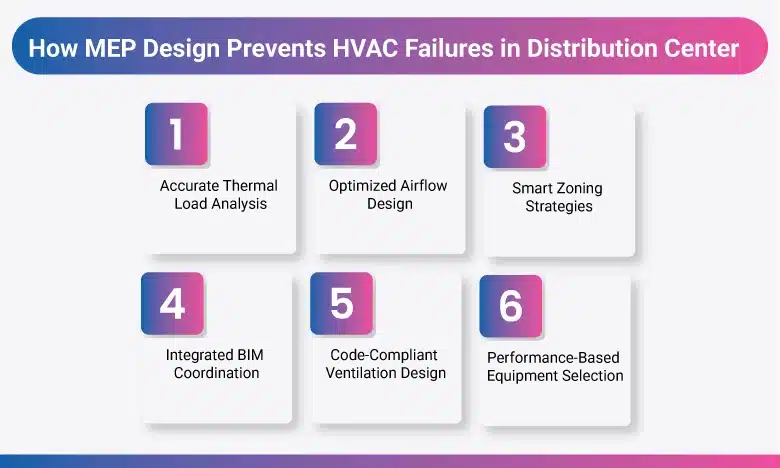
The key to preventing HVAC failures lies in engineering decisions made before construction begins.
1. Accurate Thermal Load Analysis
A properly engineered system begins with precise load calculations based on real operational data. This includes:
- Equipment heat gains
- Occupancy patterns
- Envelope performance
- Future scalability considerations
This ensures the system is designed for actual conditions not assumptions.
2. Optimized Airflow Design
Effective airflow design ensures that conditioned air is distributed evenly throughout the space.
Key strategies include:
- Strategic supply and return air placement
- Destratification methods for high-ceiling environments
- Optimized duct routing for large open areas
This eliminates hot and cold spots and improves overall efficiency.
3. Smart Zoning Strategies
Dividing distribution centers into functional HVAC zones significantly improves performance.
Typical zoning includes:
- Docking zones
- Storage and racking zones
- Office and administrative areas
Each zone can then be controlled independently based on actual demand, reducing energy waste.
4. Integrated BIM Coordination
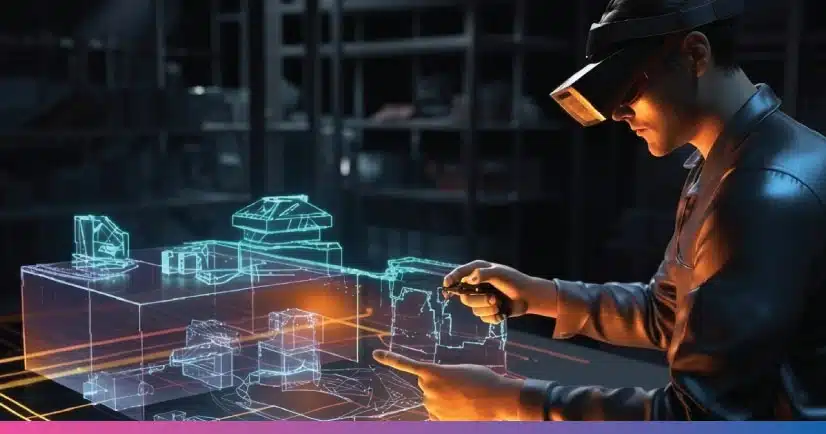
Building Information Modeling (BIM) plays a critical role in modern MEP design.
It enables:
- Early clash detection between systems
- Accurate spatial coordination with structural and architectural elements
- Improved installation accuracy and reduced rework
This ensures that design intent is maintained throughout construction.
5. Code-Compliant Ventilation Design
A well-designed ventilation system ensures both compliance and performance.
This includes:
- Adherence to ASHRAE and local building codes
- Balanced fresh air and exhaust systems
- Proper air change rates for all functional areas
The result is improved indoor air quality and regulatory compliance.
6. Performance-Based Equipment Selection
Rather than selecting equipment based solely on capacity, performance-based design focuses on:
- Energy efficiency
- Lifecycle operating cost
- Load variability
- Long-term reliability
This ensures that systems operate efficiently under real-world conditions.
Why Early MEP Involvement Matters
One of the most important factors in HVAC success is timing.
Early involvement of MEP engineers enables:
- Better integration with architectural layouts
- Optimized system routing and placement
- Reduced design conflicts and construction changes
- Improved energy performance outcomes
Late-stage HVAC design, on the other hand, often leads to compromises that negatively affect system efficiency and long-term performance.
Best Practices for High-Performance Distribution Centers HVAC Design
To achieve reliable HVAC performance in distribution centers, industry best practices include:
- Conducting detailed load analysis during concept design
- Implementing zone-based HVAC strategies
- Integrating BIM coordination from early stages
- Designing airflow based on actual operational workflows
- Optimizing duct and equipment layout for large spans
These practices ensure that HVAC systems are both efficient and resilient.
How MVN Engineering Supports AEC Firms
MVN Engineering partners with US-based AEC firms as an offshore extension of their MEP design teams, supporting HVAC design, BIM coordination, and construction documentation for industrial and commercial projects.
- HVAC design for residential, commercial and Industrial
- MEP system coordination and documentation
- Load calculations and system optimization
- BIM modeling and clash detection support
By integrating with your in-house teams, MVN Engineering helps AEC firms improve delivery speed, reduce workload pressure, and maintain high-quality engineering standards across projects.
Conclusion
HVAC system failures in distribution centers are rarely the result of equipment issues alone. In most cases, they stem from early-stage design decisions, insufficient coordination, and a lack of integrated MEP planning.
When HVAC systems are designed with accurate load analysis, proper zoning, and coordinated MEP workflows, they become reliable, efficient, and scalable assets rather than ongoing operational challenges.
Ultimately, successful HVAC performance begins long before installation begins with engineering design.