
Introduction
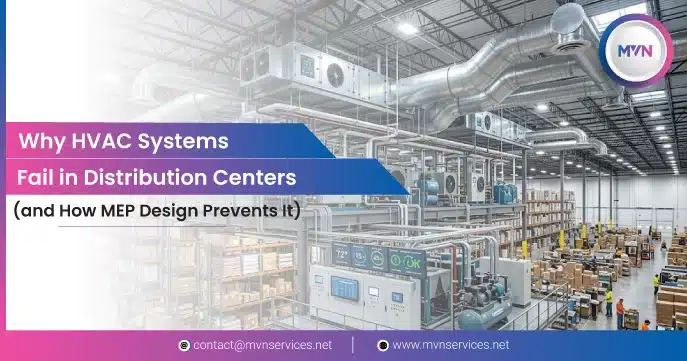
Warehouse HVAC design in Texas faces some of the most demanding environmental and operational conditions. Extreme summer temperatures, large building footprints, and high internal heat loads create significant challenges for HVAC system performance.
Even when modern HVAC equipment is installed, many warehouses continue to experience:
- Uneven cooling across zones
- Excessive energy consumption
- Hot air accumulation near ceilings
- Poor airflow distribution
- Frequent system overloading
In most cases, these issues are not caused by equipment failure but by poor HVAC system design and lack of coordinated MEP engineering during the design phase.
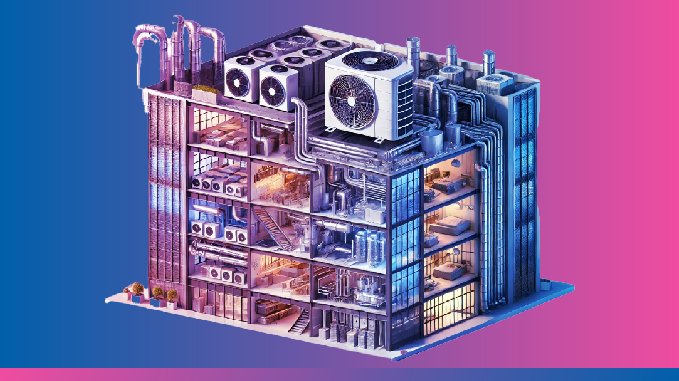
A warehouse HVAC system is not just a mechanical installation, it is a fully integrated system that must align with architectural, structural, and electrical design, structure, electrical systems, and operational requirements. Without proper coordination, HVAC performance will always fall short.
This article explains the key HVAC design challenges in Texas warehouses and how proper MEP engineering solves them.
Rising Energy and MEP Demand Across U.S. Commercial Buildings
In 2025 and 2026, total U.S. electricity consumption is projected to reach record highs, with industrial and commercial usage approaching historical peaks. This increase is directly impacting large-scale facilities such as warehouses, where cooling, lighting, and overall MEP system demand continues to rise.
Within commercial buildings, HVAC systems alone account for approximately 40–50% of total energy consumption, making mechanical system design one of the most critical factors influencing long-term operating costs and building performance.
For warehouse projects in Texas, this trend creates additional pressure on design teams. High outdoor temperatures combined with rising energy demand mean that poorly designed HVAC systems can significantly increase operational expenses and reduce system efficiency.
As a result, effective MEP engineering is no longer just about system functionality it must balance:
- Energy efficiency and long-term cost control
- Indoor environmental quality and occupant comfort
- Compliance with evolving energy codes and standards
This makes early-stage HVAC and MEP design decisions essential for ensuring warehouse projects remain efficient, compliant, and financially sustainable over time.
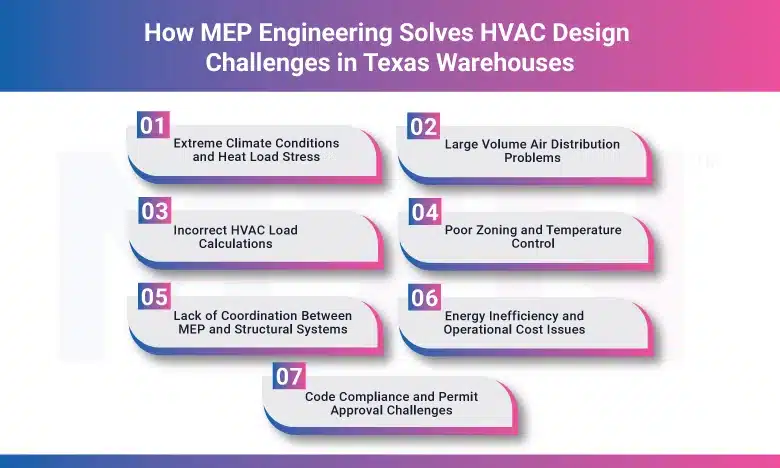
How MEP Engineering Solves HVAC Design Challenges in Texas Warehouses
1. Extreme Climate Conditions and Heat Load Stress
Texas experiences long, hot summers with temperatures often exceeding design comfort conditions. Warehouses, due to their large surface areas and metal roofing systems, absorb and retain significant heat.
Key challenges:
- High solar heat gain through roofs and walls
- Continuous heat buildup inside large open spaces
- Increased cooling demand during peak summer months
- Difficulty maintaining stable indoor temperature
Engineering impact:
Standard HVAC assumptions often fail to capture real-world heat gain, resulting in underperforming systems.
MEP engineering solution:
Proper HVAC design includes:
- Accurate ASHRAE-based heat load calculations
- Roof and envelope heat gain modeling
- Realistic occupancy and equipment load assumptions
- Peak summer condition simulation
This ensures the system is designed for actual Texas climate stress conditions, not theoretical averages.
2. Large Volume Air Distribution Problems
Warehouses typically have high ceilings (25–40 feet or more) and large open floor areas. This creates a phenomenon called thermal stratification, where hot air rises and remains near the ceiling while cooler air stays at the working level.
Common issues:
- Uneven temperature distribution
- Cold spots near floor level
- Overworked HVAC systems
- Increased energy consumption
Engineering solution:
MEP HVAC design addresses this through:
- High-volume low-speed (HVLS) fans
- Destratification air circulation systems
- Optimized diffuser placement
- Zoned air distribution strategies
The goal is to maintain consistent temperature across the occupied zone rather than cooling unused upper air space.
3. Incorrect HVAC Load Calculations
One of the most common design failures in warehouse HVAC systems is inaccurate load calculation during the design phase.
Common mistakes:
- Ignoring solar heat gain from roofing systems
- Underestimating equipment and machinery heat loads
- Not accounting for frequent dock door openings
- Oversimplified occupancy assumptions
Engineering impact:
Incorrect load calculations lead to:
- Oversized systems (high energy cost)
- Undersized systems (poor performance)
- Reduced equipment lifespan
MEP engineering solution:
Professional MEP engineers use:
- ASHRAE-compliant calculation methods
- Carrier HAP or equivalent simulation tools
- Dynamic load modeling
- Real-world operational data inputs
This ensures HVAC systems are correctly sized and optimized for long-term performance.
4. Poor Zoning and Temperature Control
Warehouses are not single-function spaces. They include:
- Storage areas
- Packaging zones
- Office spaces
- Loading docks
Each zone has different cooling requirements.
Common issues:
- Uniform HVAC design across all spaces
- No independent temperature control
- Inefficient airflow distribution
Engineering solution:
Proper HVAC zoning includes:
- Multi-zone system design
- Independent thermostatic control
- Demand-based ventilation strategies
- Separate air handling units where required
This ensures each functional zone receives appropriate conditioning based on usage.
5. Lack of Coordination Between MEP and Structural Systems
Many HVAC design failures occur due to poor coordination between mechanical, structural, and architectural systems.
Common problems:
- Ductwork conflicts with beams and trusses
- Insufficient clearance for HVAC equipment
- Improper mechanical room placement
- Electrical load mismatches
Engineering impact:
These conflicts lead to:
- Construction delays
- On-site modifications
- Increased project cost
MEP engineering solution:
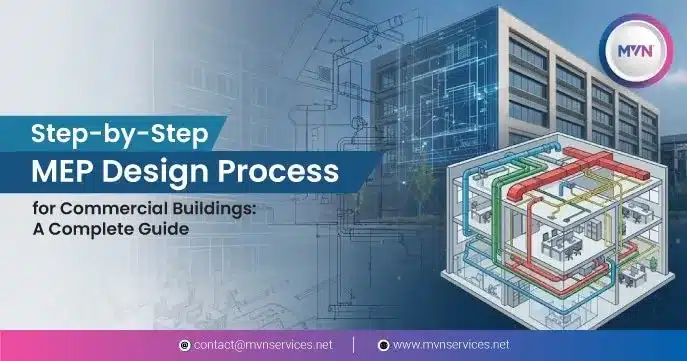
BIM-based coordination ensures:
- Clash detection before construction
- Fully integrated 3D modeling
- Optimized routing of ducts and pipes
- Proper spatial planning for all systems
This significantly reduces construction-stage surprises.
6. Energy Inefficiency and Operational Cost Issues
Warehouse HVAC systems in Texas operate for long hours due to extreme temperatures, making energy efficiency critical.
Common inefficiencies:
- Continuous full-load system operation
- Lack of automation or controls
- Poor insulation coordination
- Inefficient air circulation patterns
Engineering solution:
Energy-efficient MEP design includes:
- Energy recovery ventilation (ERV systems)
- Smart building management systems (BMS integration)
- Demand-controlled ventilation
- High-efficiency HVAC equipment selection
This reduces long-term operational cost while maintaining comfort conditions.
7. Code Compliance and Permit Approval Challenges
Warehouse HVAC systems in Texas must comply with:
- International Mechanical Code (IMC)
- ASHRAE standards
- Local energy compliance requirements
Common issues:
- Incomplete mechanical documentation
- Non-compliant ventilation calculations
- Missing energy compliance reports
Engineering impact:
- Plan check rejection
- Delayed approvals
- Additional redesign cycles
MEP engineering solution:
Proper design ensures:
- Full compliance from initial design stage
- Complete documentation packages
- Energy modeling reports included in submissions
- Accurate code-based system design
The performance of a warehouse HVAC system is not determined during installation—it is defined much earlier, during the design and coordination phase.
Why Early MEP Engineering Involvement Makes the Difference in Warehouse Projects
In many Texas warehouse projects, especially fast-track or build-to-suit developments, design and construction activities often overlap. When MEP engineering is introduced too late, systems are forced into already constrained layouts, leading to coordination conflicts, redesigns, and performance issues.
Early MEP involvement establishes a strong engineering foundation before design decisions are finalized.
Key benefits of early-stage MEP engineering:
- Accurate HVAC load calculations based on real operational and climate conditions
- Efficient airflow planning and zoning strategies aligned with warehouse usage
- BIM-based clash detection before permit submission, reducing on-site conflicts
- Coordinated integration of mechanical, electrical, and plumbing systems with architecture and structure
- Early identification of long-lead equipment, such as electrical infrastructure and HVAC units
- Code-compliant documentation aligned with permitting requirements
- Constructible, clash-free design drawings that minimize RFIs and rework
Without early MEP coordination, warehouse HVAC systems often face:
- Design revisions during construction
- Increased project costs
- Delays in permitting and execution
- Long-term performance inefficiencies
In contrast, when MEP engineering is integrated early in the project lifecycle, it enables smoother coordination, faster approvals, and more predictable construction outcomes while ensuring the HVAC system performs as intended under real-world conditions.
What Architects and Developers Should Expect from a Warehouse MEP Partner
Avoiding redesigns, permit delays, and costly coordination issues in warehouse projects starts with choosing the right MEP engineering partner.
Warehouse projects in Texas require more than basic system design. They demand a deep understanding of Texas energy codes, fast-track construction workflows, and real-world coordination challenges between architectural, structural, and building systems.
How MVN Engineering support warehouse HVAC and MEP projects:
- HVAC system design and accurate load calculations based on Texas climate conditions and operational demands
- BIM-based MEP coordination and clash detection to resolve conflicts before construction begins
- Construction-ready drawings and documentation aligned with real-world installation requirements
- Code compliance support, including Texas energy standards and local permitting requirements
- Permit submission assistance to streamline plan check approvals and reduce revision cycles
We collaborate closely with architects, developers, and contractors to ensure that MEP systems are not only designed but fully coordinated, code-compliant, and buildable.
By integrating engineering expertise early and leveraging advanced coordination workflows, we help project teams:
- Reduce RFIs and on-site conflicts
- Improve constructability and installation efficiency
- Avoid costly redesigns and delays
- Deliver high-performance, energy-efficient warehouse buildings
With the right MEP partner involved from the beginning, warehouse projects move forward with greater clarity, smoother execution, and far fewer surprises from design through construction.
Conclusion
HVAC challenges in Texas warehouses are rarely caused by equipment failure; they are primarily the result of gaps in engineering design and system coordination. When proper MEP engineering is applied from the early stages, HVAC systems are designed to perform efficiently while meeting code requirements, controlling costs, and ensuring long-term reliability. A well-coordinated approach also results in systems that are fully constructible, minimizing on-site conflicts and rework during construction. Ultimately, early-stage MEP coordination plays a critical role in preventing most HVAC issues, ensuring that warehouse projects move forward with better performance, smoother execution, and fewer delays.