Avoiding Common Mistakes and Special Considerations for High-Rise Buildings
Fire protection design plays a critical role in ensuring life safety, asset protection, and regulatory compliance across all building types. From commercial developments to complex high-rise structures, a professional Fire Protection Design Service helps integrate code-compliant systems that reduce risk and enhance overall building safety. A well-engineered fire protection system can mean the difference between controlled containment and catastrophic loss.
Why Fire Protection Design Is Critical in Modern Buildings?
As buildings grow taller and more complex, fire risks increase due to higher occupant loads, vertical fire spread, and extended evacuation times.
Fire protection system design ensures:
- Early fire detection and alarm activation
- Safe and efficient occupant evacuation
- Effective fire suppression and smoke control
- Compliance with NFPA, IBC, and local AHJ requirements
- Reduced property damage and downtime
Fire protection is not just a regulatory requirement. It is a core component of building performance and resilience.
6 Pro Tips for Fire Protection System Design
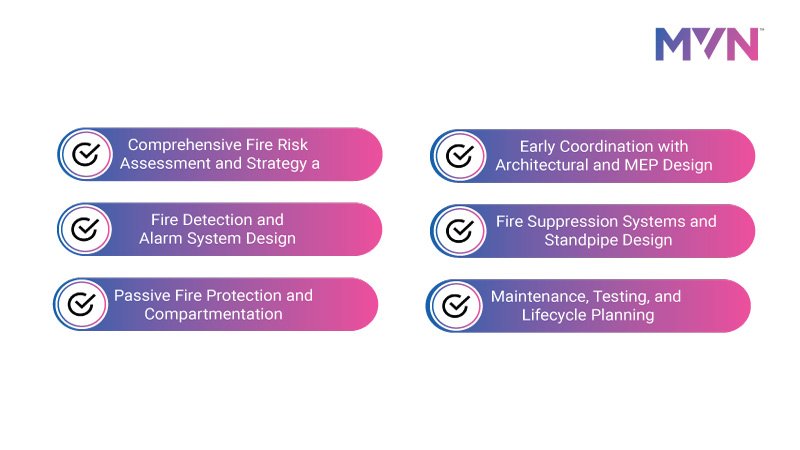
Comprehensive Fire Risk Assessment and Strategy
Every effective fire protection system begins with a detailed fire risk assessment. This includes evaluating building occupancy, fire load, materials, height, area, and emergency response access.
A documented fire strategy defines how detection, suppression, compartmentation, smoke control, and evacuation systems work together. For large and high-rise buildings, performance-based fire engineering and fire modeling are often required in addition to prescriptive code compliance.
Early Coordination with Architectural and MEP Design
Fire protection systems must be coordinated early with architectural, mechanical, electrical, and plumbing layouts. Poor coordination is one of the leading causes of sprinkler obstructions, compromised fire ratings, and inspection failures.
Using BIM-based coordination helps:
- Avoid clashes between sprinklers, ductwork, and lighting
- Maintain fire-rated assemblies at penetrations
- Optimize riser locations and fire pump room layouts
Early integration improves constructability and reduces costly redesigns.
Fire Detection and Alarm System Design
Fire detection and alarm systems provide the first warning during a fire emergency. Modern fire alarm systems typically include smoke detectors, heat detectors, manual pull stations, and voice evacuation systems.
Best practices include:
- Hazard-based detector placement
- Zoning aligned with evacuation strategy
- Voice evacuation systems for high-rise and assembly occupancies
- Integration with elevators, smoke control, and fire doors
Regular testing and commissioning are essential to maintain system reliability.
Fire Suppression Systems and Standpipe Design
Fire suppression systems are designed to control or extinguish fires, allowing safe evacuation and firefighting operations. Common systems include automatic sprinklers, standpipe systems, and special hazard suppression systems.
Key design considerations:
- Hydraulic calculations for worst-case demand
- Proper sprinkler zoning and control valves
- Redundant water supplies and backup power
- Standpipe systems for high-rise firefighter access
- System selection must align with building use, risk profile, and code requirements
Passive Fire Protection and Compartmentation
Passive fire protection limits the spread of fire and smoke without mechanical activation. This includes fire-rated walls, floors, shafts, firestopping, and smoke barriers.
Best practices focus on:
- Continuous fire-resistance-rated construction
- Proper firestopping at all penetrations
- Coordinated fire and smoke dampers
- Regular construction-phase inspections
Passive systems are often compromised due to poor coordination or workmanship, making oversight essential.
Maintenance, Testing, and Lifecycle Planning
Fire protection design must consider long-term operation. Systems should be accessible, testable, and maintainable throughout the building lifecycle.
Design teams should plan for:
- Clear access to valves, detectors, and control panels
- Defined inspection, testing, and maintenance schedules
- As-built documentation and system manuals
- Facility staff training
A system that cannot be maintained will eventually fail, regardless of design quality.
Conclusion
Fire protection design is a critical discipline that demands careful planning, coordination, and long-term thinking. From fire risk assessment and system selection to high-rise evacuation planning and smoke control, every decision impacts life safety and building performance.
High-rise buildings require an even higher level of rigor, with advanced suppression, communication, and redundancy strategies. By following proven best practices and avoiding common mistakes, project teams can deliver safer, more resilient buildings.
At MVN Engineering Services, we provide fire protection design solutions that are practical, code-compliant, and aligned with real-world building operations. Our focus is on systems that perform when they are needed most.